


Duplicate Providers Are Rarely an Accident
Most organizations don’t discover a duplicate provider problem in real time.
They find it later — during a system conversion, a directory audit, or a reconciliation effort that refuses to line up cleanly.
By then, duplicates feel historical. Inevitable. The product of years of data moving through multiple systems.
In reality, duplicate provider records are created through a small number of repeatable decisions made under pressure. They are not random, and they are rarely the result of carelessness.
They are the predictable outcome of unresolved provider identity.
The Exact Moment Duplication Begins
Every duplicate provider record starts the same way.
A claim arrives, and the system cannot confidently determine whether the provider already exists.
Matching logic hesitates. Similar names appear. Addresses don’t fully align. Identifiers don’t reinforce one another.
At that moment, a decision has to be made.
Either the claim pauses for further investigation — or a new provider record is created so the claim can move forward.
That decision point is where duplication begins.
Why New Record Creation Feels Like the Safer Choice
Under throughput pressure, creating a new provider record often feels lower risk than linking to the wrong one.
A mis-linked provider can cause immediate downstream issues. A new record rarely does — at least not right away.
So when confidence is low, teams default to the option that clears the claim with minimal short-term exposure.
This behavior isn’t careless. It’s rational.
The system has stopped because it can’t be confident — and manual work fills the gap.
Lookup Tools Increase Decision Frequency
Lookup tools surface possibilities, not answers.
When lookup results return multiple similar records, staff are forced to interpret context:
- Are these the same provider?
- Are the differences meaningful?
- Is this a new location or a formatting variation?
Different people will answer those questions differently, especially under time pressure.
Over time, inconsistent decisions accumulate.
This isn’t a training issue. It’s a structural consequence of asking humans to resolve identity repeatedly at scale.
Why Incomplete Context Accelerates Duplication
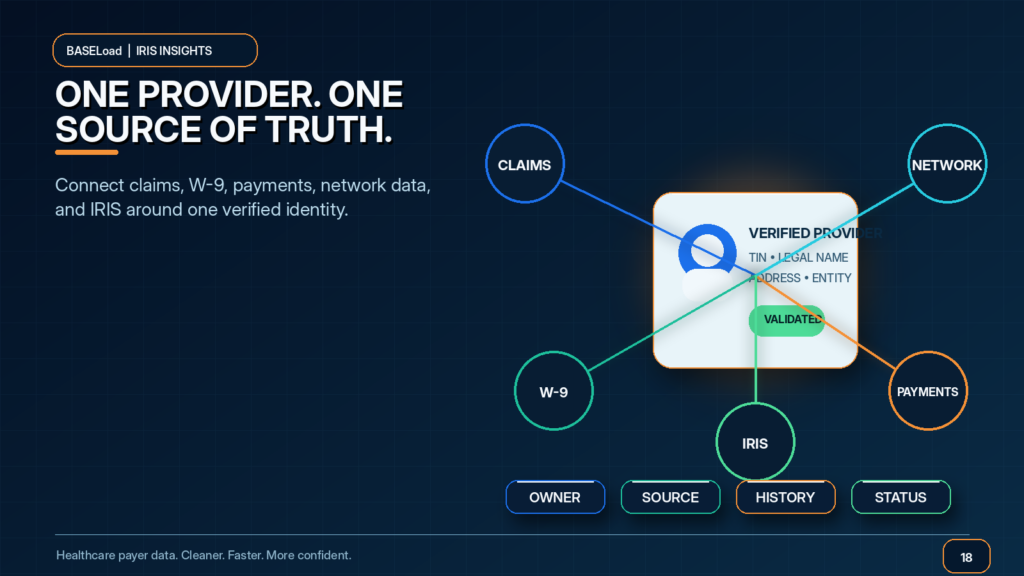
Duplicate creation is far more likely when supporting data does not reinforce itself.
Common contributors include:
- Missing or masked Tax IDs
- Inconsistent address structure
- Unclear billing relationships
- Multiple service locations without role clarity
When confidence drops, new record creation becomes the path of least resistance.
The more often this happens, the more fragmented the provider dataset becomes.
NPIs Don’t Eliminate Duplicate Risk
It’s reasonable to assume that NPIs should prevent duplicates entirely.
In practice, they don’t.
The same NPI may appear:
- Paired with different Tax IDs
- Across multiple locations
- In both individual and organizational roles
Without clear role separation and contextual structure, systems either hesitate — or defer the decision to humans.
The NPI hasn’t failed. It simply isn’t sufficient on its own to resolve identity safely.
Duplication Makes Matching Harder Over Time
Once duplicate records exist, future matching becomes more difficult.
The system now encounters:
- Multiple plausible matches
- Conflicting historical relationships
- Reduced confidence signals
As confidence drops, more claims fail to match automatically.
More failures mean more manual decisions.
More manual decisions mean more duplicates.
The cycle reinforces itself.
The Downstream Cost of Duplicate Providers
Duplicate provider records fragment history.
Payments, services, and reporting are split across multiple identities. Reconciliation becomes more complex. Analytics lose reliability.
During conversions or audits, duplicates increase risk and extend timelines.
What once felt like a harmless workaround becomes a long-term operational liability.
Why Cleanup Alone Doesn’t Break the Cycle
Many organizations attempt to address duplication through cleanup initiatives.
These efforts reduce visible duplicates — temporarily.
But cleanup does not change how identity decisions are made during live processing.
If matching confidence remains low upstream, duplicates reappear as soon as normal operations resume.
Prevention Starts Earlier Than Most Teams Expect
Preventing duplicate providers does not require perfect data.
It requires:
- Earlier identity resolution
- Clear confidence thresholds
- Fewer forced judgment calls
When identity can be resolved confidently before a new record is created, duplication slows naturally.
A Better Question to Ask
Instead of asking why duplicate providers exist, organizations that make progress ask:
Why are we being asked to decide provider identity manually so often?
That question shifts focus from cleanup to prevention.
The Takeaway
Duplicate provider records are not accidents.
They are signals that identity resolution is happening too late, under too much pressure, and with too little confidence.
When provider matching is treated as an upstream control point, duplication becomes rare.
When it is treated as cleanup, duplication is inevitable.
Understanding how duplicates are created is the first step toward stopping the cycle.
Where BASELoad Fits
Duplicate providers don’t start as a data problem — they start as a confidence problem at the moment identity needs to be resolved.
BASELoad addresses that moment directly. By establishing provider identity earlier and with clearer confidence thresholds, it reduces the need for “safe” new record creation that leads to duplication over time.
If duplicate providers are showing up downstream, the fix usually isn’t cleanup — it’s upstream resolution.
→ Contact us to see how BASELoad helps prevent duplication before it starts.
Educational Note
This article is for educational purposes only and does not constitute legal, tax, or regulatory advice. Operational outcomes may vary by organization and system environment.
Stay compliant—tomorrow beckons.