

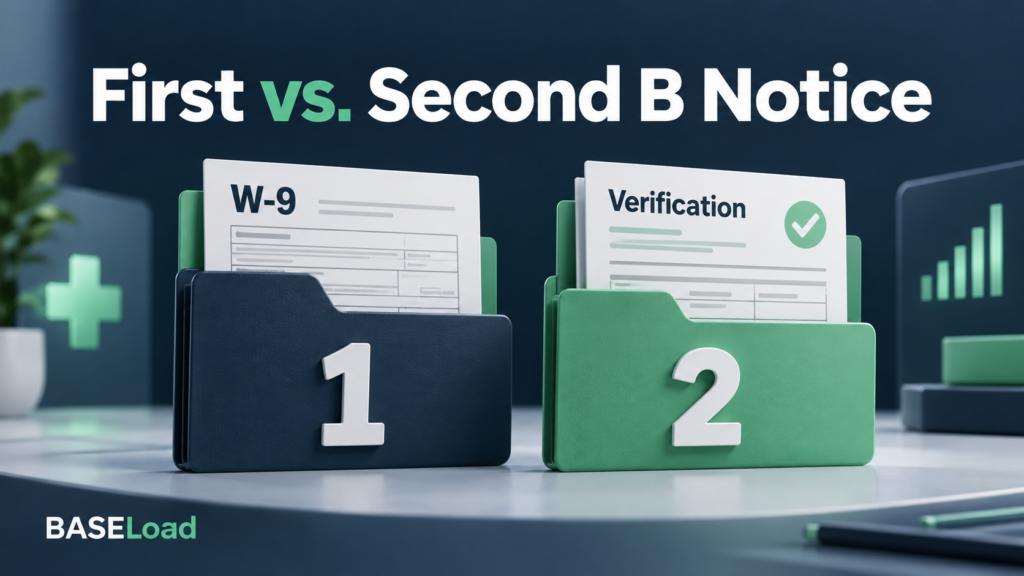
The difference between a first and second B notice matters because the required response is not the same. A first applicable notice generally requests a certified name and taxpayer identification number through Form W-9. A second applicable notice within the relevant three-calendar-year period requires a different validation process. Sending the same W-9 package twice can leave a payer with the wrong evidence for the case.
Healthcare payers need a reliable account history to make this distinction. Provider records may move between systems, change internal IDs, or be managed by different teams over time. This guide focuses on how to classify notice history, request the right response, and document the decision using IRS Publication 1281 as the authoritative procedural reference.
First compare the IRS listing with your records
A CP2100 or CP2100A notice is the starting point for review. Compare the listed name, TIN, and account information with the payer’s records. The IRS instructions distinguish incorrect records that agree with the listing from discrepancies caused by changes, reporting errors, or other issues. The first-versus-second decision follows that review; it should not be applied blindly to every line in the incoming file.
Preserve the original notice and the version of the reporting data that produced the return. A current provider record can differ from the historical one. If staff look only at today’s values, they may miss that an approved correction was made after filing or that the export used a value different from the source record.
What does the first B notice require?
For a first applicable incorrect-name/TIN notification, the payer sends the first B notice and Form W-9 or an acceptable substitute following the IRS instructions. The purpose is to solicit the correct certified name/TIN combination. Use the required notice language and packaging requirements rather than replacing the notice with an informal email asking the provider to confirm details.
Track the package sent, mailing date, address, response, and review outcome. When the provider returns documentation, evaluate it under the applicable procedure and preserve it with the account history. Do not assume that a different-looking name is automatically correct or that an unchanged value automatically means the provider ignored the request. The documentation and IRS procedure govern the next action.
What changes for a second B notice?
For a second applicable notification within the relevant three-calendar-year period, Publication 1281 directs a different notice and validation process. The second package should not include another Form W-9 as if it were a first notice. The payee must follow the appropriate IRS or Social Security Administration validation route, depending on the circumstances described in the publication.
Your reviewer should identify the evidence required for that account and explain the approved return process. Avoid inventing an alternative document standard based on what is convenient to collect. A business card, directory listing, or unsigned email may explain a practice name, but it is not automatically the validation required for a second B-notice case.
The difference should be reflected in your tracking system. A first-notice case might be awaiting the required W-9 certification; a second-notice case might be awaiting the required agency validation. Calling both statuses “waiting for W-9” encourages staff to send the wrong follow-up and makes management reports misleading.
Count notices using the IRS rules, not a simple letter count
The payer must determine whether an account has a first or second applicable notification. Publication 1281 includes exceptions involving repeated notices in the same calendar year or notices relating to the same account and reporting year. Two pieces of correspondence do not always equal a first and second B notice. Review the underlying dates and circumstances before selecting the package.
Maintain notice date, receipt date, reporting year, account reference, recipient identity, and disposition. When systems change, retain the link between the old and new account references. A migration that preserves payment data but loses notice history can undermine the next response decision. Include notice-history continuity in acquisition and conversion planning.
Keep mailing and withholding timing separate
The IRS generally gives payers 15 business days from the notice date or receipt date, whichever is later, to send an applicable B notice. Publication 1281 separately explains when backup withholding must start and when it can stop after the required certification or validation. Those timing rules should be calculated and reviewed by the responsible tax team.
A collection dashboard should show the next required action, its deadline, and its owner. It should not suggest that the legal timeline pauses while a provider promises to reply. Coordinate any withholding decision with the payment operations team and retain evidence that the approved action was actually implemented.
Example: why one template is not enough
Consider an illustrative payer reviewing two provider accounts. One has its first applicable incorrect-name/TIN notification after the listing is reconciled to records. The other has a qualifying prior notification within the relevant period. Both cases involve tax-identity information, but their required response packages differ. A single mass request for W-9s would conceal that distinction.
The payer creates two approved workflows and reviews exceptions before mailing. When documents arrive, staff compare each response with the standard for its workflow. A document that closes the first case does not necessarily close the second. The case record explains the decision, so a different reviewer can understand it months later.
Separate routine W-9 outreach from formal notices
A payer may request updated tax information during onboarding, data cleanup, ownership changes, or preparation for filing. Those routine requests should be clearly identified as such. Do not label a general collection campaign a B notice when it is not part of the IRS notice procedure. Providers need to understand why they are being contacted and what response is required.
Similarly, do not replace a formal B-notice package with a routine outreach template. Use approved supporting instructions for secure return logistics, but preserve the required notice text and process. The IRS requester instructions for Form W-9 are useful for collection design; Publication 1281 supplies the notice-specific procedure.
How BASELoad supports the surrounding data work
BASELoad’s W-9 Corrections and 1099 Corrections services can support provider outreach and tax-data preparation. Bring a categorized exception summary to the conversation and explain whether the work concerns routine collection, formal notices, or both. Agree on the documentation, escalation rules, and progress reporting needed by your internal reviewers.
Keep the tax determination and any backup-withholding decisions with an explicitly assigned qualified owner. Data preparation support is most useful when its outputs fit that review process. Ask how approved changes will reach the authoritative provider record and the next filing dataset so the same issue is less likely to recur.
A final review before closing the account case
Confirm that the notice classification is supported, the correct package was sent, the response meets the applicable requirement, and the downstream actions are documented. Preserve the history for future notice analysis and follow your approved retention policy. Do not close a case solely because correspondence was received or a field was changed.
For related preparation guidance, see the payer guide to W-9 B notices and the IRIS Resource Hub. Contact BASELoad to discuss provider-data support. Apply current IRS instructions and professional tax advice to the specific notice and account facts.