

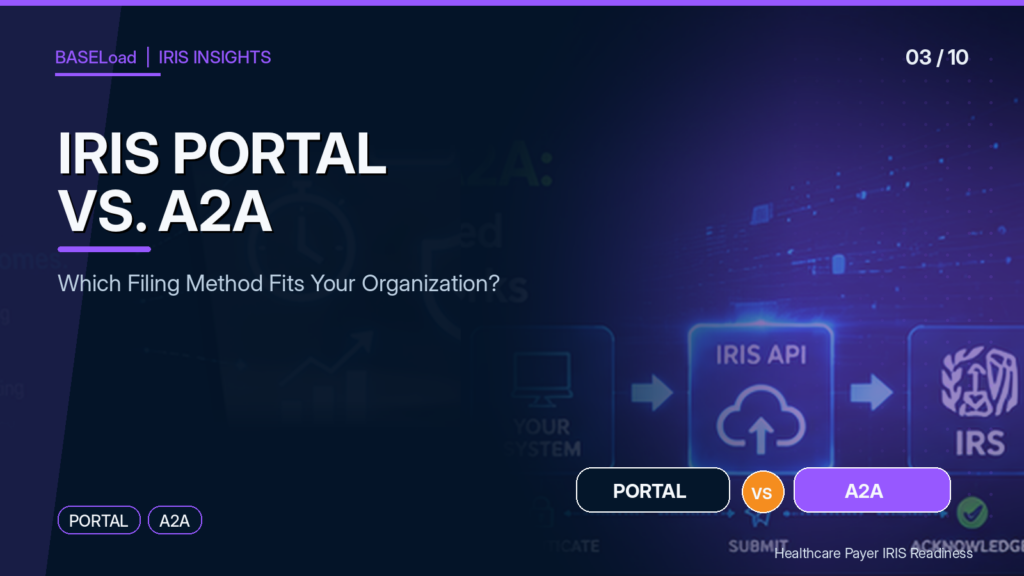
The IRS Information Returns Intake System offers two primary filing channels.
That makes the decision sound simple.
Choose the portal or choose A2A.
But for healthcare payers, TPAs, PPOs, health plans, workers’ compensation organizations, and benefits administrators, the correct choice depends on more than filing volume.
It depends on how provider data is collected, how many records must be processed, how frequently corrections occur, who owns transmission, what internal systems are involved, how acknowledgments will be monitored, and how much manual work the organization can realistically absorb.
The filing method is not just a technical selection.
It becomes part of the operating model.
What Is the IRIS Taxpayer Portal?
The IRIS Taxpayer Portal is a free, web-based system that allows filers to prepare and submit information returns without purchasing specialized filing software.
The current IRS guidance says the Portal allows users to:
- File up to 100 returns at a time
- Enter information manually
- Upload information through a CSV file
- Download payee copies
- Maintain records of completed, filed, and distributed forms
- Manage issuer information
The Portal also supports corrections and automatic-extension requests for eligible information returns.
The Portal can be useful for organizations with lower filing volume, straightforward data, limited integration needs, and staff available to manage the filing process directly.
It provides an accessible on-ramp to IRIS.
But accessible does not always mean operationally efficient.
What Is IRIS A2A?
Application to Application allows information returns to be transmitted from approved software or a third-party service into IRIS.
A2A is designed for bulk filing and system-based workflows. It uses IRS schemas and structured XML rather than relying on manual browser entry.
The IRS describes A2A as the option for filers using third-party software, filing services, or internally developed software. Current guidance says A2A can support thousands of returns and transmission payloads up to 100 MB at a time.
A2A introduces additional onboarding requirements, including:
- An appropriate IRIS A2A TCC
- An API Client ID
- Access to the relevant schema package
- Assurance Testing System transmissions
- Successful testing before production use
The attached IRIS materials similarly distinguish the Portal as the smaller-volume channel and A2A as the XML-based bulk-filing method.
Volume Is Important, but It Is Not the Only Question
A small filer may be well served by the Portal.
A large healthcare payer probably will not be.
However, the record count alone does not settle the decision.
An organization filing 500 returns with highly complex provider data, frequent corrections, multiple source systems, and limited internal staffing may benefit from an automated or outsourced process.
Another organization with a larger count but an unusually clean, centralized dataset may have different options.
The better question is:
How much operational handling does each return create?
A return that is clean, complete, and ready for submission is one thing.
A return tied to an uncertain legal name, invalid TIN, missing address, unresolved provider record, or incomplete W-9 is something else.
The filing method should be chosen based on the full workflow, not just the number of rows.
When the Taxpayer Portal May Make Sense
The Portal may fit organizations that have:
- Relatively low filing volume
- A limited number of issuers
- Clean, centralized data
- Staff available for manual review
- Few corrections
- Minimal need for system integration
- Straightforward internal approvals
- No requirement for high-volume automation
The Portal also allows a filer to avoid building an A2A connection or purchasing specialized software.
That can reduce technical complexity.
But it may increase manual effort.
Someone still has to prepare the data, upload or enter it, monitor the filing, investigate errors, download records, distribute copies, and maintain documentation.
For a small filing population, that may be reasonable.
For a large payer, the portal can become a narrow doorway in front of a very wide crowd.
When A2A May Be the Better Fit
A2A is generally better aligned with organizations that have:
- Large filing populations
- Multiple source systems
- Recurring or automated filing processes
- Third-party filing support
- Internal software capabilities
- A need for scalable acknowledgments and status tracking
- Frequent correction or replacement activity
- Strong audit and reporting requirements
- Limited tolerance for manual entry
Healthcare payer organizations commonly manage provider records across claims, payment, contracting, credentialing, network, and tax workflows.
A2A can support a more integrated submission process, but it does not remove the need to standardize and validate data before transmission.
Automation can move good data quickly.
It can also move bad data quickly.
Consider the People Behind the Process
Portal versus A2A is also a staffing decision.
A Portal workflow may require employees to:
- Prepare CSV files
- Review uploads
- Resolve validation messages
- Monitor submission status
- Download payee copies
- Maintain filing records
- Complete corrections manually
An A2A workflow may require:
- Technical implementation
- Credential management
- Software maintenance
- Schema updates
- Testing
- Error mapping
- Status monitoring
- Vendor coordination
Neither method is labor-free.
The labor simply appears in different places.
The Portal tends to place more responsibility in direct user handling. A2A places more responsibility in software, integration, vendor management, and automated operations.
Leadership should understand where the work will land before approving the method.
Consider Corrections Before Choosing
Many organizations choose a filing method based on how originals will be submitted.
That is only half the decision.
The IRS advises organizations using third-party software or transmitters to confirm that the provider supports the capabilities the business requires, including corrections and replacements. Not every product or service necessarily supports every IRIS function.
Healthcare payers should evaluate:
- How a TIN or legal-name correction will be filed
- How an incorrect amount will be corrected
- How a rejected submission will be replaced
- How Receipt IDs and record identifiers will be retained
- How accepted-with-errors statuses will be handled
- Whether the selected software supports every required correction type
- Who will furnish corrected recipient copies
A filing method that works beautifully for originals but collapses during corrections is not a complete solution.
Consider Security and Access
Both filing channels involve sensitive taxpayer and provider information.
For the Portal, organizations need controls around user access, authorized accounts, file preparation, downloads, local storage, and employee turnover.
For A2A, organizations need controls around credentials, software access, sensitive data storage, transmission records, logging, vendor access, and API-related processes.
A practical review should identify:
- Who can view TINs
- Who can prepare files
- Who can submit returns
- Who can access acknowledgments
- Where files and payee copies are stored
- How access is removed when an employee leaves
- How vendor access is monitored
- How sensitive data is protected in logs and reports
The filing channel may change.
The responsibility to safeguard data does not.
Consider Status Visibility
The Portal maintains records of completed and filed forms.
A2A provides Receipt IDs, acknowledgments, and structured transmission statuses.
In either case, leadership needs a clear answer to one question:
How will we know the filing was accepted?
A screenshot showing that someone clicked a button is not enough.
A file sitting in a “sent” folder is not enough.
A vendor email saying “completed” may not be enough without the underlying acknowledgment.
A sound process should retain:
- What was submitted
- When it was submitted
- Who submitted it
- Which issuer was involved
- The IRS Receipt ID or corresponding filing record
- The final status
- Any errors returned
- Any corrections or replacements
- Evidence of recipient-copy distribution
The selected method should make that evidence easier to manage.
A Simple Decision Framework
When comparing the IRIS Taxpayer Portal vs A2A, ask five questions.
How many returns do we file?
Higher volume usually strengthens the case for A2A or third-party support.
How clean is our data?
Messy data increases work in either channel. The difference is whether that work occurs before submission or during error cleanup.
How much manual handling can we support?
A Portal workflow may be inexpensive from a software perspective but costly in staff time.
How complex are our corrections?
Frequent or complicated corrections require a method that supports them reliably.
Do we have the technical and vendor support needed for A2A?
A2A requires more setup, but that setup may provide a more scalable long-term process.
Final Thoughts
The Portal and A2A are not competing versions of the same button.
They represent different operating models.
The Portal offers accessibility and direct control for lower-volume filers. A2A offers greater scalability and automation for organizations with higher volume or more complex filing needs.
For healthcare payers, the best choice should reflect the full life cycle of provider information, from W-9 collection and data cleanup through submission, acknowledgment, correction, and record retention.
The right filing channel is the one your organization can operate reliably under pressure.
BASELoad Can Help You Choose and Prepare for the Right IRIS Method
BASELoad can help healthcare payers assess the data and operational requirements surrounding their IRIS filing method.
That support can include reviewing provider 1099 data, resolving TIN and legal-name mismatches, correcting addresses, collecting W-9 information, reducing manual cleanup, and preparing a more reliable dataset for the selected filing workflow.
Contact BASELoad to evaluate whether your current provider-data and 1099 process is ready for the Portal, A2A, or a supported third-party filing model.