

Healthcare payers rarely operate within tidy geographic boundaries.
A health plan may serve members in multiple states.
A TPA may administer benefits for employers across the country.
A PPO may maintain provider relationships in dozens of jurisdictions.
A workers’ compensation organization may issue payments to providers whose tax, mailing, and service addresses cross state lines.
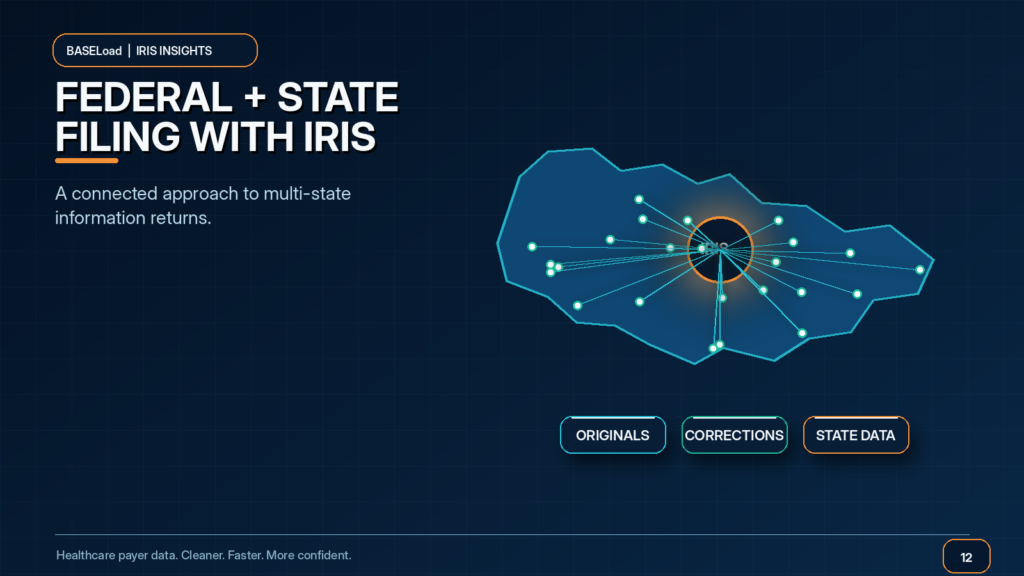
That makes the IRIS Combined Federal State Filing Program relevant to many payer organizations.
Commonly called CF/SF, the program allows the IRS to forward eligible original and corrected information returns to participating states. Its purpose is to simplify part of the state information-return filing process.
But “simplify” does not mean “fully automate every state obligation.”
Healthcare payers still need to understand enrollment, supported forms, state-specific requirements, multi-state payment allocation, testing, corrections, and data mapping before relying on CF/SF.
What Is the IRIS Combined Federal State Filing Program?
The Combined Federal/State Filing Program allows the IRS to electronically send eligible information returns to participating states.
This can reduce the need to prepare completely separate files for every state.
The attached IRS materials state that both original and corrected information returns can be forwarded through the program.
For payer organizations with a broad provider network, this creates a potentially valuable filing path.
Instead of treating the federal and state processes as disconnected projects, the organization may be able to use information submitted through IRIS to support participating-state reporting.
However, CF/SF is not a universal state-filing switch.
Not every state participates.
Not every form is supported.
State requirements can change.
A state may still require direct registration, separate reconciliation forms, additional data, withholding accounts, or other filings.
The organization remains responsible for determining what each state requires.
Participation Begins with the IRIS TCC Application
Organizations planning to participate in CF/SF must identify that intent during the IRIS TCC application process.
The IRS materials describe this as a consent and disclosure decision. The filer must indicate that it wants to participate and consent to the IRS sharing applicable return data with participating states.
Software Developers must also indicate whether their software supports CF/SF.
If the software package claims to support the program, the relevant schema elements must be included in testing, and a CF/SF scenario must be included in the IRIS Assurance Testing System process.
This means payer organizations should not wait until state filing season to ask whether CF/SF was enabled.
The decision affects:
- TCC application information
- Software configuration
- Data mapping
- Testing
- State fields
- Vendor responsibilities
- Correction workflows
CF/SF readiness begins during onboarding.
Which Forms Are Supported?
For the processing-year materials reviewed, the IRS lists several information returns as eligible for CF/SF, including:
- Form 1099-B
- Form 1099-DIV
- Form 1099-G
- Form 1099-INT
- Form 1099-K
- Form 1099-MISC
- Form 1099-NEC
- Form 1099-OID
- Form 1099-PATR
- Form 1099-R
- Form 5498
Forms 1099-MISC and 1099-NEC will be especially relevant to many healthcare payer organizations.
Supported forms can change by processing year.
Before filing, organizations should confirm the current IRS schema, business rules, CF/SF form list, and state requirements rather than assuming the prior-year configuration remains valid.
Participating States Can Change
The attached Publication 5718 includes a list of participating states and the District of Columbia for the applicable processing year.
The publication also makes an important point: each state’s requirements are subject to change, and the filer is responsible for verifying the state’s criteria and special data-entry requirements.
That responsibility cannot be outsourced to the existence of the program itself.
A state appearing on the CF/SF list does not automatically confirm that:
- The payer has met every registration requirement
- Every required state form is covered
- A separate state reconciliation is unnecessary
- The state accepts every federal correction automatically
- No direct filing is needed
- State withholding data is complete
- The provider’s state allocation is accurate
The CF/SF list should be the beginning of the state review, not the end.
Multi-State Payments Require Deliberate Allocation
The IRS materials state that CF/SF participants may report payments and withholding for multiple states.
When the same payment is reportable to more than one state, the amounts must be prorated among the relevant states.
This can be challenging for healthcare payers because provider records may contain several geographic indicators:
- Provider service location
- Billing address
- Mailing address
- Tax address
- Corporate headquarters
- Payment address
- Network location
- Member location
- Employer-group location
Those fields do not necessarily answer the same tax-reporting question.
The organization needs documented rules for determining which state or states apply to a payment.
Without that governance, state allocation may depend on whichever address happened to be available in the export.
A technically complete state field can still be operationally wrong.
State Data Should Be Prepared Upstream
CF/SF readiness is not simply a matter of adding a two-letter state code to the final file.
The payer should prepare and validate:
- State abbreviation
- State identification number, when required
- State income
- State tax withheld
- Local information, when applicable
- Provider location data
- Payment allocation
- Form eligibility
- State participation
- Correction references
The source of each field should be documented.
For example, if state income is calculated in a payment platform but state withholding is stored in a separate finance system, the filing team needs a controlled method for bringing those values together.
The final file should not be the first place where those systems meet.
Corrections Need a State Strategy Too
The IRS can forward eligible corrected information returns to participating states through CF/SF.
That is helpful, but healthcare payers still need to determine what happens after a correction is submitted.
Questions to address include:
- Does the state require an additional direct notification?
- Does the provider need a corrected recipient copy?
- Was the original state allocation wrong?
- Does the correction affect withholding?
- Is a state reconciliation form also affected?
- Does the software support CF/SF corrections?
- Will the filing vendor provide confirmation of state forwarding?
- How will the correction be documented internally?
A federal correction should not be treated as proof that every related state obligation has been completed.
The payer needs a process for following the correction through the state layer.
CF/SF Must Be Included in Testing
When a software package will support CF/SF, the ATS test package must include the relevant schema elements and an applicable CF/SF test scenario.
The current IRS ATS examples indicate that CF/SF information is required on one of the specified software-test submissions when participation has been selected.
Testing should confirm:
- The state code is valid
- State amounts are mapped correctly
- Required state fields are present
- The elected form supports CF/SF
- The software includes the appropriate indicator
- The transmission receives Accepted status
- The relevant Receipt ID and submission information are retained
Testing only a federal-only record may leave the state process unverified.
Build a State Filing Matrix
A practical CF/SF operating tool is a state filing matrix.
For each state in which the organization may have reportable provider payments, document:
- Whether the state participates in CF/SF
- Which forms are eligible
- Whether direct registration is required
- Whether a separate state filing is required
- Whether a reconciliation form is required
- Applicable payer identification numbers
- Filing deadlines
- Recipient-copy rules
- Correction procedures
- Internal owner
- Vendor responsibility
- Source of state payment data
This matrix should be reviewed before every filing season.
State rules can move quietly. A stale matrix can create confident mistakes.
Confirm What the Filing Vendor Supports
A vendor may support IRIS A2A without supporting CF/SF.
Another may support CF/SF for some forms but not others.
Another may transmit the state data but provide limited reporting about what was forwarded.
Ask the vendor:
- Does your software support CF/SF?
- Which forms are supported?
- Which processing year was tested?
- Are corrections supported?
- Can multiple states be reported for one recipient?
- How are prorated amounts handled?
- Which state fields must we provide?
- Do we receive state-level confirmation?
- What remains our responsibility?
- What happens when a state does not participate?
The answers should be documented in the operating agreement.
Use CF/SF to Simplify, Not to Assume
The Combined Federal/State Filing Program can reduce duplication.
But its value depends on the quality of the data and the clarity of the process surrounding it.
Healthcare payers should treat CF/SF as one component of a multi-state compliance strategy.
The organization still needs:
- Accurate provider identity data
- Reliable state mapping
- Valid payment allocation
- Current state requirements
- Tested software
- Documented responsibilities
- Correction procedures
- Filing evidence
CF/SF can create efficiency.
Assumption can erase that efficiency quickly.
Final Thoughts
The IRIS Combined Federal State Filing Program provides healthcare payers with a structured way to send eligible federal information-return data to participating states.
It does not eliminate the need for state analysis.
Organizations must elect participation correctly, confirm software support, test the required schema elements, validate state data, prorate multi-state amounts when necessary, and verify each state’s current requirements.
The strongest CF/SF process connects federal filing, state reporting, provider data, payments, corrections, and documentation.
BASELoad Can Help You Navigate IRIS and Multi-State Provider Data
BASELoad helps healthcare payers improve the provider information behind federal and state reporting. Its W-9 Corrections process can identify TIN and legal-name mismatches, improve provider addresses, support provider outreach, process files from multiple systems, and help prepare cleaner information before filing.
Cleaner provider identities and better address data create a stronger foundation for CF/SF state mapping and correction workflows.
Contact BASELoad to review the provider-data risks that could complicate your organization’s IRIS Combined Federal State Filing Program.