

FIRE retirement deadlines is no longer a distant planning topic for healthcare payers. The IRS has confirmed that FIRE will retire before the 2027 filing season, making the Information Returns Intake System the required intake platform for tax year 2026 information returns. Organizations that treat the transition as a simple endpoint change may discover too late that credentials, data rules, testing, controls, and operating responsibilities all need to change together.
The practical objective is a deadline-driven transition plan. That means translating a federal platform change into reliable day-to-day work across tax, finance, provider operations, data, security, technology, and outside partners. named actions tied to November 2026 milestones provide the foundation. Without them, assuming filing season 2027 leaves time to transition becomes much more likely.
BASELoad helps healthcare payers prepare the provider and payment data behind information returns, resolve identity and tax-data issues, and establish a repeatable path from source records to filing-ready output. The result is not merely a file that can be transmitted. It is a controlled process that leaders can understand, operators can execute, and auditors can reconstruct.
Why FIRE retirement deadlines matters now
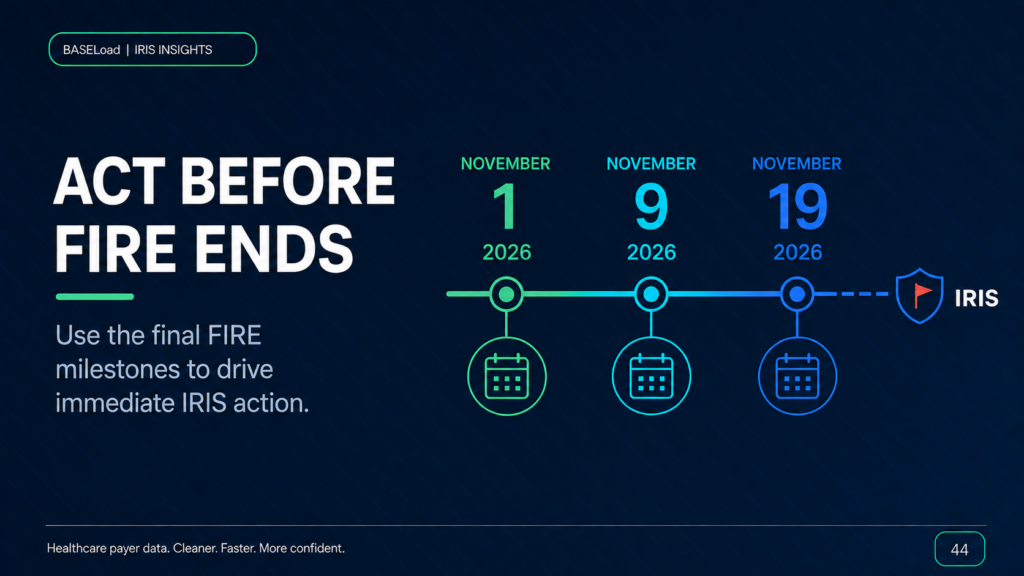
IRIS became available as part of the IRS modernization of information-return filing, but the approaching end of FIRE turns optional preparation into an operational deadline. According to the IRS transition reminder, FIRE test submissions end November 1, 2026, changes to FIRE TCC applications end November 9, and production FIRE filing ends November 19 at 3 p.m. Eastern. Those dates matter because they remove the legacy path before the next major filing season begins.
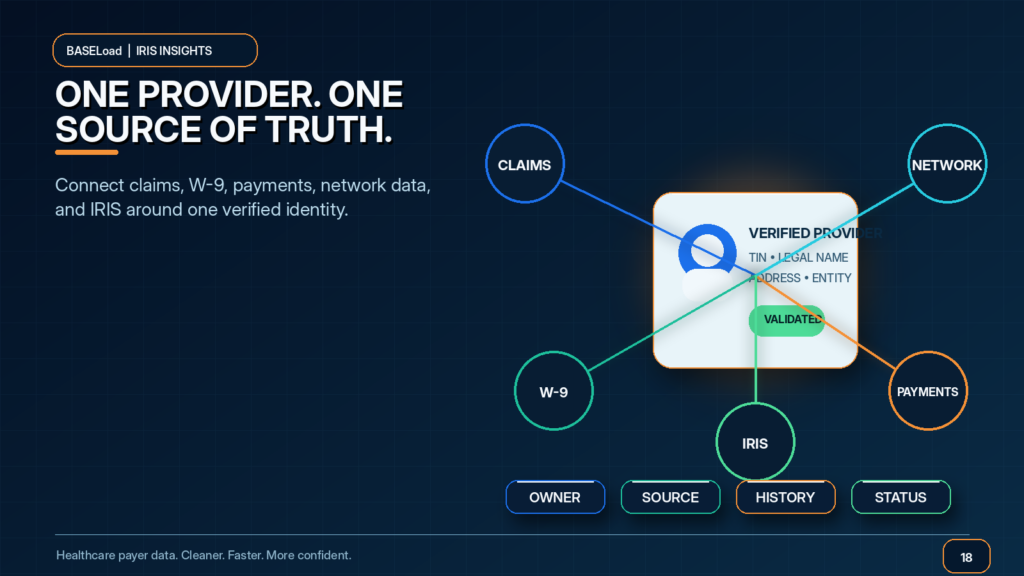
Healthcare payer environments are unusually dependent on connected provider data. A reported amount may originate in claims, accounts payable, contracting, credentialing, network management, or a delegated vendor. Legal names and taxpayer identification numbers may be stored differently across those systems. A successful FIRE retirement deadlines program therefore has to address the chain of custody for data, not just the final transmission step.
The electronic-filing threshold also deserves attention. The IRS generally requires electronic filing when a filer submits an aggregate of ten or more covered information returns. For most payer organizations, electronic filing is therefore not a matter of preference. It is a baseline compliance requirement that makes dependable IRIS operations essential.
Define the outcome before choosing the work
A useful program begins with an explicit outcome: accurate, complete, authorized information returns submitted through the correct IRIS channel, acknowledged on time, supported by retained evidence, and correctable when an exception occurs. That outcome gives every workstream a common definition of success.
Leaders should convert that outcome into acceptance criteria. Examples include approved IRIS access, a complete issuer and form inventory, validated field mappings, reconciled control totals, tested submission and acknowledgment handling, documented correction procedures, trained users, and a rehearsed continuity plan. Each criterion should have an accountable owner, evidence requirement, and target date.
This approach keeps FIRE retirement deadlines from becoming a collection of disconnected activities. It also allows executives to distinguish between motion and readiness. A meeting held, document drafted, or test started is not the same as a control demonstrated under realistic conditions.
Build a practical FIRE retirement deadlines workstream
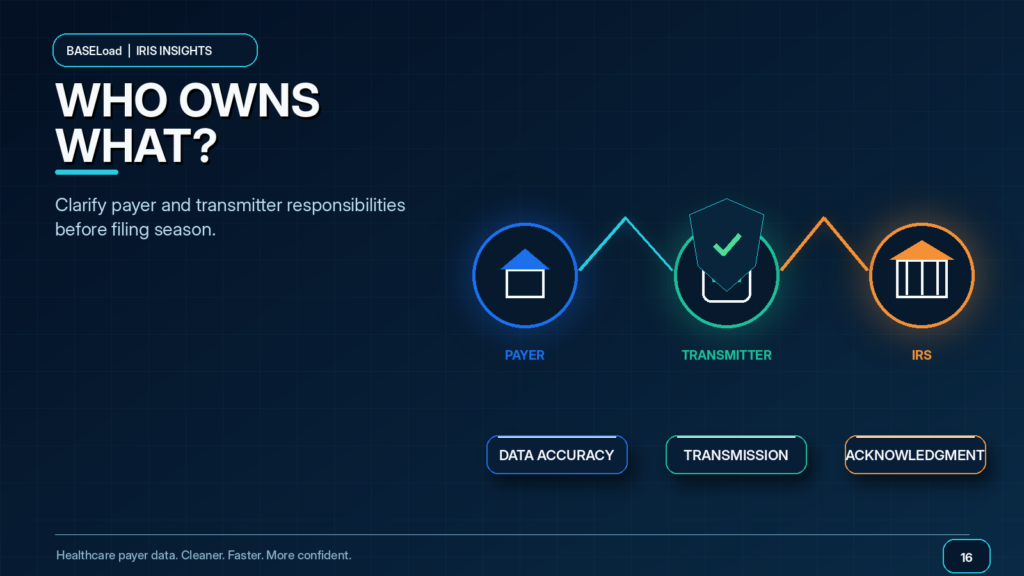
Start with the people who understand the data and the filing obligation. Tax or finance may own the return, but provider operations often understands identity changes, contracting understands entity relationships, information security governs access, and technology teams understand transformations and interfaces. Bring these perspectives together early and give one leader authority to resolve cross-functional issues.
Next, document the current process from source event to accepted return. Capture systems, files, manual adjustments, vendors, approvals, timing, control totals, exception queues, and retained evidence. The map should show what happens when information is incomplete or contradictory. Hidden work is common in established filing processes, especially where experienced employees compensate for weak upstream data through spreadsheets or personal knowledge.
Then design the target process around IRIS rather than recreating the legacy FIRE workflow. The IRS IRIS filing guidance describes two channels: the Taxpayer Portal for manual entry or CSV uploads of up to 100 returns at a time, and Application to Application for software-enabled, higher-volume transmission. Channel selection should reflect volume, frequency, control needs, technical capability, and the operating model—not convenience alone.
Put provider data quality ahead of transmission
Provider information is frequently fragmented across internal and external sources. One clinician or organization may have multiple internal identifiers, payment relationships, tax entities, addresses, or legacy records. Before a payer can trust a filing, it must determine which records represent the same real-world party and which tax identity should receive the reported amount.
Effective preparation includes normalization, identity resolution, TIN and name validation, duplicate analysis, exception ownership, and payment reconciliation. Rules should be explainable and repeatable. When an automated match or survivorship decision changes a filing value, the organization should be able to show the source records, logic, approval, and downstream impact.
BASELoad supports this work by helping payers consolidate and cleanse provider data, surface conflicts, and create a more reliable filing foundation. This is especially valuable when multiple legacy systems or delegated relationships feed the same reporting population. Better data reduces avoidable rejections, correction effort, provider outreach, and filing-season stress.
Test the whole operating model
Technical testing is necessary but incomplete. A schema-valid transmission can still fail operationally if the wrong entity approved it, an acknowledgment is not monitored, a rejected record has no owner, or a correction cannot be linked to the original submission. Tests should cover the full sequence and include realistic failures.
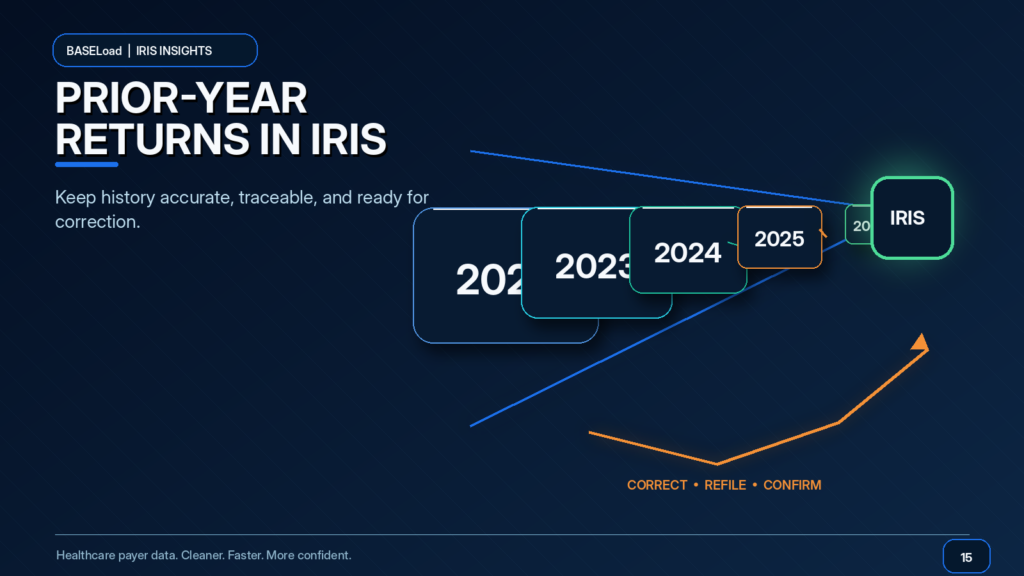
Create scenarios for accepted files, validation errors, partial exceptions, duplicate records, late provider changes, prior-year activity, corrected returns, unavailable staff, vendor delays, and platform disruption. Record expected results before execution. Preserve test inputs, outputs, acknowledgments, screenshots where appropriate, issue decisions, and retest evidence.
Business users should participate in testing rather than receiving a completed system at the end. They are best positioned to evaluate whether exception messages are actionable, handoffs are clear, control totals are meaningful, and the proposed timing can work during filing season. Their sign-off should be based on observed performance.
Govern risk, access, and evidence
IRIS access and filing authority should follow least-privilege principles. Separate data preparation, approval, transmission, and reconciliation where staffing allows. Maintain current user access, remove access promptly when roles change, and avoid shared credentials. Access reviews should be scheduled and documented.
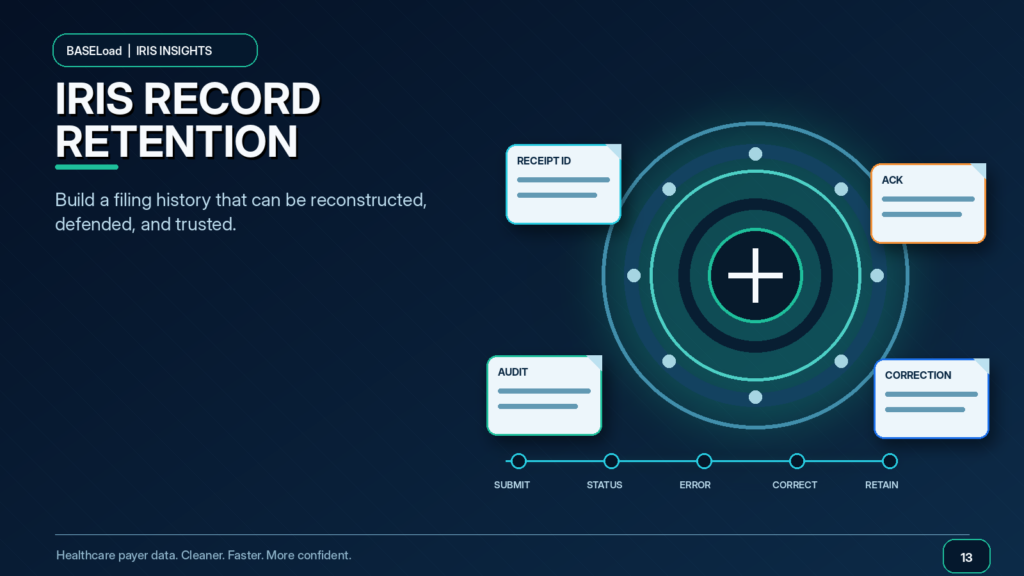
A complete evidence package should connect the approved source population to the transmitted return and the IRS response. Retain control totals, approvals, versioned files, submission identifiers, acknowledgments, exception decisions, corrections, and relevant communications under the organization’s retention policy. Evidence should be searchable without relying on one employee’s mailbox.
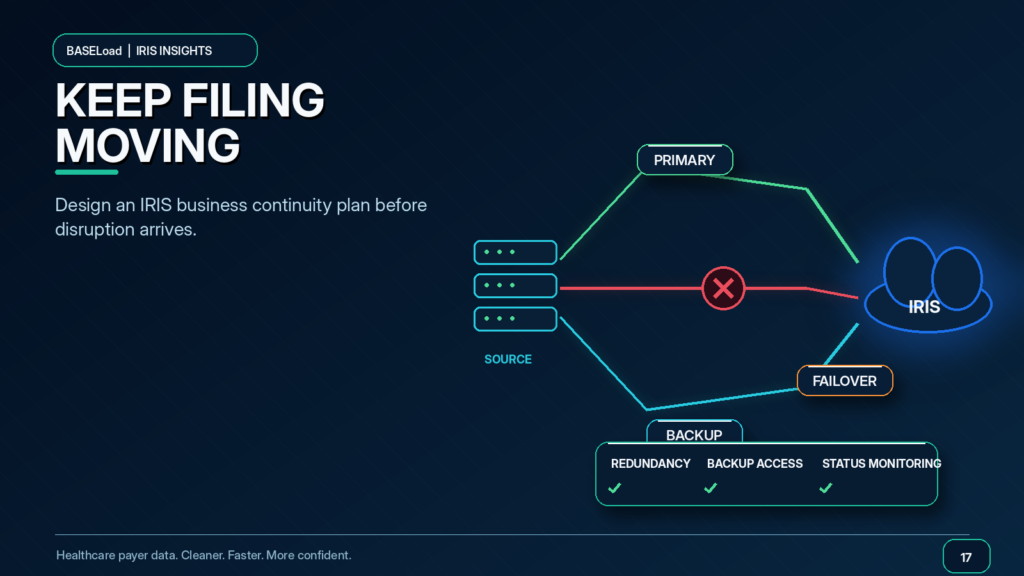
Risk governance also requires contingency plans. Identify alternate personnel, backup access, manual workarounds, vendor escalation paths, decision thresholds, and communication responsibilities. Rehearse the plan before a disruption occurs. A continuity document that has never been exercised offers limited assurance.
How BASELoad strengthens FIRE retirement deadlines
BASELoad combines healthcare payer experience with provider-data discipline. The team can help identify upstream dependencies, evaluate data quality, reconcile provider identities, organize remediation, and support the controls needed to move accurate data into an IRIS-ready filing process.
That support can be tailored to the organization’s operating model. Some payers need a focused assessment and roadmap. Others need hands-on data cleanup, implementation support, vendor coordination, testing assistance, or a managed path through recurring information-return operations. The common thread is reducing uncertainty with evidence and accountable execution.
BASELoad also helps organizations use the IRIS transition as an opportunity to improve the provider-data foundation that supports more than tax reporting. Cleaner identity, ownership, address, and payment relationships can improve provider communications, operational reporting, and downstream reconciliation.
FIRE retirement deadlines: recommended next steps
First, confirm an executive sponsor and accountable program owner. Second, validate the filing scope, IRIS channel, credential status, and critical milestones. Third, baseline provider-data quality and prioritize exceptions that can threaten reporting. Fourth, complete representative end-to-end testing with documented acceptance criteria. Fifth, conduct a formal readiness review and cutover rehearsal.
Do not wait for every design question to be perfect before beginning. Start with the highest-risk dependencies and create a visible issue log. Review progress weekly, escalate decisions quickly, and require evidence before declaring a milestone complete.
If your organization needs help turning FIRE retirement deadlines into a controlled implementation, contact BASELoad. BASELoad can help assess the current state, strengthen provider data, shape the roadmap, and support the work required for a more confident IRIS transition.