

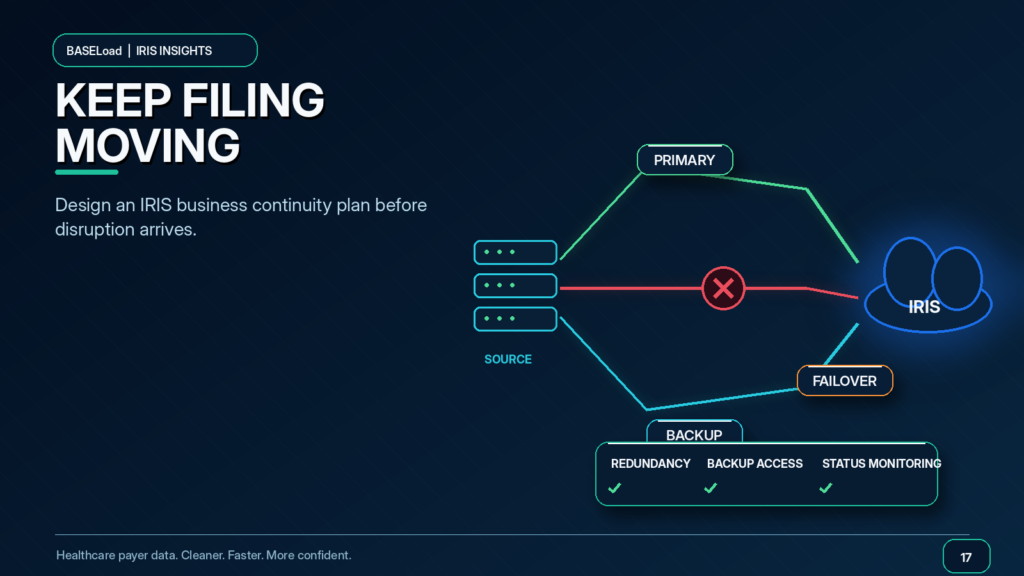
A modern filing system can improve automation, validation, and visibility.
It cannot eliminate every disruption.
Systems undergo maintenance.
Software can fail.
Credentials can expire.
Vendors can experience outages.
Employees can become unavailable.
A transmission can remain in Processing longer than expected.
An IRS-known issue can affect a specific form, schema, portal feature, or testing environment.
A provider-data problem can surface days before the deadline.
Healthcare payers should therefore include an IRIS business continuity plan within the transition.
The purpose is not to predict every failure.
It is to prevent a familiar filing process from depending on one person, one vendor, one credential, one submission window, or one undocumented workaround.
Monitor Official IRIS Issues
The IRS maintains a known-issues-and-solutions page for the Taxpayer Portal, A2A, and A2A ATS.
Issues are organized by tax year, and the IRS posts available solutions or temporary workarounds when applicable.
Payer organizations should assign someone to monitor:
- IRIS system status
- Known issues
- QuickAlerts
- Schema and business-rule updates
- ATS notices
- Working Group materials
- Scheduled maintenance
- Help Desk communications
The IRS also recommends subscribing to QuickAlerts and participating in monthly IRIS Working Group meetings to receive information about system changes, maintenance, and transition guidance.
Monitoring should be a named responsibility.
“Someone in IT probably watches that” is not a control.
Identify Critical Dependencies
Map everything required to complete the filing.
Dependencies may include:
- Source-data access
- Claims-system exports
- Provider master
- Payment reconciliation
- W-9 repository
- File-conversion software
- TCC
- API credentials
- Vendor portal
- Secure file transfer
- Approval workflow
- Authorized employees
- Receipt ID storage
- Status monitoring
- Printing and mailing
- Provider portal
- Help Desk access
For each dependency, identify:
- Primary owner
- Backup owner
- Failure scenario
- Recovery procedure
- Maximum acceptable delay
- Required documentation
- Escalation contact
This turns business continuity from a general promise into a set of operational instructions.
Do Not Build the Process Around One Employee
Many filing processes depend heavily on the person who has always handled them.
That employee may know:
- Which export to run
- Which fields to remove
- Which spreadsheet formula to use
- Which vendor contact responds fastest
- Where the TCC is stored
- How to interpret an error
- Which executive approves the file
- How to generate provider copies
That experience is valuable.
It is also a risk when it is undocumented.
At least two employees should be able to perform or supervise every critical filing function.
The backup should test access before filing season, not during the first emergency.
Submit Earlier Than the External Deadline
One of the most effective continuity controls is time.
The final FIRE submission deadline is November 19, 2026, at 3 p.m. ET, and tax year 2026 returns filed during the 2027 filing season must use IRIS.
For ongoing IRIS filing, the organization should establish internal deadlines before the applicable IRS due dates.
Earlier submission creates time to:
- Retrieve a final acknowledgment
- Resolve rejected records
- Correct provider data
- Contact the vendor
- Respond to system issues
- Obtain executive approval
- Furnish corrected recipient copies
- Escalate unresolved problems
A deadline with no recovery window is not a schedule.
It is a wager.
Plan for Processing Delays
IRIS A2A is asynchronous.
Receiving a Receipt ID does not mean the filing has reached a final status.
The process may return an initial status and require later acknowledgment retrieval.
The business continuity plan should define:
- How often Processing statuses are checked
- When a delay becomes an escalation
- Who contacts the transmitter
- Who contacts the IRS Help Desk
- What identifiers are required
- How leadership is notified
- How the filing calendar is updated
Do not repeatedly retransmit a file simply because a final status has not arrived.
Uncontrolled retries can create duplicate-filing risks.
The team should wait for the appropriate status and follow the required correction or replacement procedure.
Plan for Vendor Outages
A third-party transmitter can be a critical dependency.
The continuity plan should include:
- Primary support contact
- Escalation contact
- Emergency phone number
- Contracted response time
- Status-page location
- Backup secure-transfer method
- Export of current filing data
- Local copy of Receipt IDs
- Local copy of acknowledgments
- Correction support after an outage
- Contract-termination access
- Alternative transmitter considerations
Do not assume that switching vendors during filing season will be quick.
A new provider may need data mapping, authorization, testing, security approval, and historical records.
The better continuity strategy is to reduce the chance that an emergency switch becomes necessary.
Protect Credentials and Access
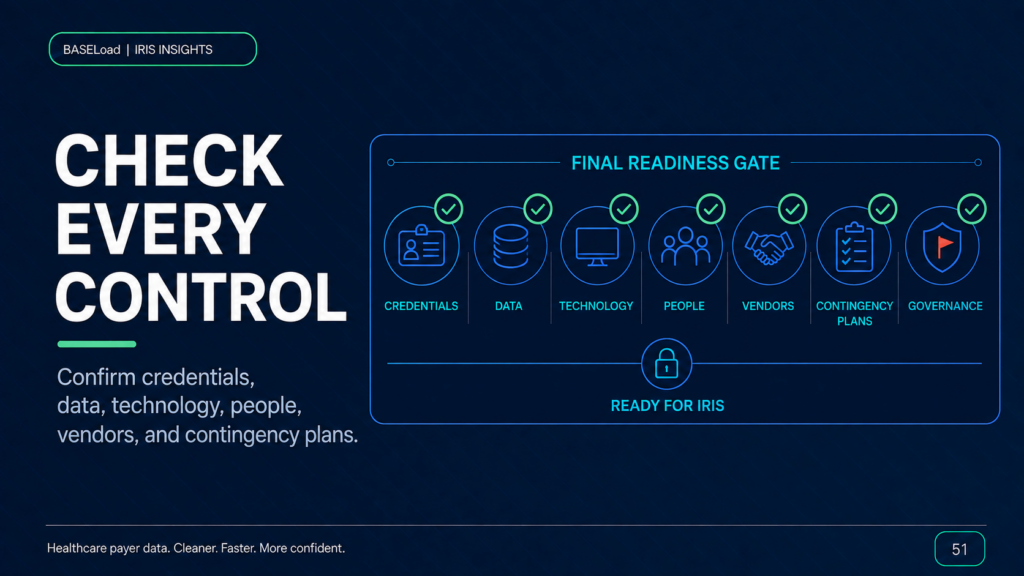
IRIS filing may depend on TCCs, IRS user accounts, API credentials, vendor logins, internal systems, and secure-transfer accounts.
Maintain an access inventory that identifies:
- Credential owner
- Authorized users
- Backup users
- Recovery method
- Expiration date
- Last access test
- Access-removal procedure
- Storage method
- Vendor relationship
- Environment
Credentials should be protected.
They should not be so closely held that filing becomes impossible when one employee is unavailable.
Security and continuity must be designed together.
Prepare for Source-System Failure
The filing connection may be ready while the source system is not.
A payer should know what happens when:
- The claims platform cannot generate the usual export
- A system conversion has altered field names
- Payment totals do not reconcile
- The provider master is unavailable
- A scheduled report fails
- A database backup must be restored
- Data from two platforms cannot be combined on time
Continuity planning should identify:
- Last reliable extract
- Backup report
- Data owner
- Reconciliation method
- Manual override authority
- Documentation requirements
- Decision criteria for delay or extension
A stale export should not be used silently.
Any fallback dataset must be reviewed and approved.
Establish an Incident Command Structure
During a significant filing issue, employees need clear communication.
A simple incident structure may include:
Incident lead
Coordinates response and decisions.
Technical lead
Handles software, credentials, schemas, transmissions, and vendor technology.
Data lead
Handles provider records, payments, W-9s, and corrections.
Compliance or tax lead
Interprets filing obligations and deadlines.
Communications lead
Updates leadership, providers, vendors, and affected departments.
Executive sponsor
Approves major decisions and resources.
This structure prevents ten people from contacting the vendor independently while no one updates the filing plan.
Run Tabletop Exercises
Before filing season, walk the team through realistic scenarios.
Examples include:
- The primary filing employee is unavailable
- The vendor portal is down
- A transmission remains in Processing
- The organization receives a Rejected status
- One submission is rejected within a larger transmission
- The TCC information does not match
- A provider-data export is incomplete
- Recipient copies cannot be downloaded
- A known IRS issue affects the form
- An incorrect file is approved for submission
Ask what each person would do.
Record unanswered questions.
Update procedures.
The exercise is successful when it finds gaps, not when everyone declares the plan flawless.
Create a Communication Template
When an incident occurs, leadership needs a consistent update.
The report should state:
- What happened
- Which issuer and forms are affected
- Number of records affected
- Current IRS status
- Deadline impact
- Workaround
- Owner
- Next action
- Next update time
- Decision required
Avoid vague updates such as “IRIS is having issues.”
Specific information allows leadership to make specific decisions.
Review the Plan After Every Filing Season
Business continuity improves through evidence.
After filing, review:
- Actual incidents
- Processing delays
- Vendor performance
- Access problems
- Data-export failures
- Repeated errors
- Communication gaps
- Workarounds used
- Time required for recovery
- Procedures that were outdated
Update the plan while the experience is still fresh.
A continuity plan that is never revised becomes historical fiction with a corporate template.
Final Thoughts
An IRIS business continuity plan should protect the complete filing process, not only the technical connection.
Healthcare payers need backups for people, credentials, data, software, vendors, communication, and decision-making.
The goal is not to guarantee that nothing fails.
The goal is to make sure a failure does not erase visibility, ownership, evidence, or time.
BASELoad Can Help Reduce Provider-Data Disruptions During IRIS Filing
BASELoad’s proactive W-9 Corrections process reviews healthcare provider data throughout the year, supports provider outreach, corrects TIN and legal-name combinations, improves addresses, and processes quarterly mock files before live season.
Resolving more provider exceptions before filing can remove one of the largest sources of last-minute disruption from the continuity plan.
Contact BASELoad to strengthen the provider-data layer of your organization’s IRIS business continuity plan.