

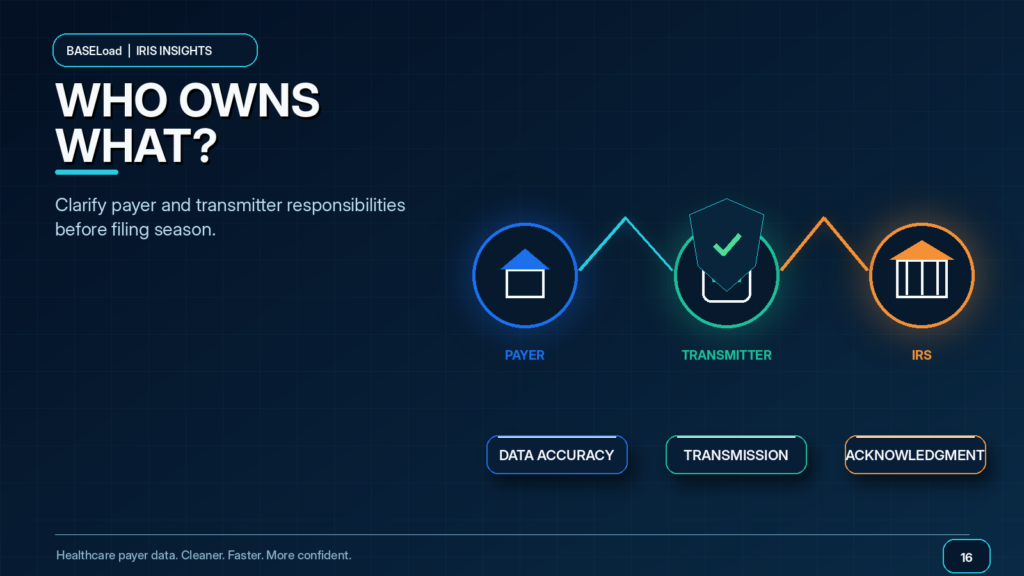
Outsourcing transmission can reduce work.
It does not erase accountability.
Many healthcare payers will use a third-party transmitter to file information returns through IRIS. That may be the most practical model for organizations that do not want to develop an A2A integration or operate the filing connection internally.
The third party may manage software, credentials, file transmission, acknowledgment retrieval, and technical support.
The payer still owns critical business responsibilities.
It must provide accurate data, verify that the service supports required capabilities, approve the filing population, retain evidence, monitor final status, protect provider information, and maintain the ability to complete future corrections.
Understanding IRIS third-party transmitter responsibilities therefore requires two questions:
- What will the transmitter do?
- What must the healthcare payer continue to control?
The second question is often where risk hides.
Understand the Transmitter’s Role
Under IRIS, a Transmitter is an organization that sends information-return data directly to the IRS on behalf of one or more businesses.
A Transmitter may also file its own returns.
A payer using a third party may not need to operate the technical filing connection itself, but it should understand which TCC is being used and which entity is authorized to communicate with the IRS about the transmission.
Publication 5718 notes that only the transmitter can communicate with the IRS about transmissions it submitted.
This gives the vendor an important operational role.
It also creates dependency.
If the transmitter is slow to respond, unavailable, or unclear about status, the payer may not be able to resolve the IRS issue independently through ordinary support channels.
Not Every Transmitter Supports Every Capability
The IRS specifically warns that some third-party transmitters may not support all IRIS capabilities, including corrections and replacements.
The filer is responsible for making sure the chosen service supports its business needs.
Healthcare payers should confirm support for:
- Original filings
- Corrections
- Replacements
- Prior-year returns
- Multiple issuers
- Combined Federal/State Filing
- Automatic extensions
- Accepted with Errors workflows
- Partially Accepted transmissions
- Recipient copies
- Complete acknowledgment exports
- Record-level error reporting
A vendor capable of submitting an original 1099-NEC file may still be unable to support the full filing life cycle.
The contract should describe supported functions precisely.
The Payer Still Owns Data Accuracy
A transmitter can validate file structure.
It cannot automatically determine whether the payer selected the correct taxpayer.
Healthcare provider records may include:
- Individual names
- Practice names
- Legal entities
- Doing-business-as names
- Group TINs
- Individual TINs
- Historical addresses
- Payment addresses
- Billing addresses
- Multiple internal provider IDs
The payer remains responsible for making sure the submitted data reflects the intended provider and payment relationship.
A vendor may identify that a required field is missing.
It may not know that the populated legal name belongs to the wrong entity.
That requires provider-data knowledge, W-9 validation, source-system review, and business ownership.
Obtain Complete Submission Evidence
The IRS instructs organizations using a third-party transmitter to obtain:
- A copy of all electronic records in each submission
- The Receipt ID for the transmission
- The final acknowledgment
- The completed status
- A detailed list of errors
These records are critical if the transmitter later goes out of business or becomes unavailable to file corrections.
Do not accept a generic “filed successfully” email as the entire evidence package.
The payer should be able to verify:
- Which records were transmitted
- When they were transmitted
- Which Receipt ID was returned
- Whether every submission was accepted
- Which records had errors
- Whether corrections were completed
- What the final status became
Evidence should be delivered routinely, not only upon request.
Define Responsibility Before Filing Season
Create a responsibility matrix covering the full filing process.
Payer responsibilities may include:
- Source-data extraction
- Provider identity validation
- Payment reconciliation
- W-9 collection
- Filing approval
- Recipient communication
- Vendor oversight
- Record retention
- Management reporting
Transmitter responsibilities may include:
- File conversion
- Schema validation
- Secure transmission
- Receipt ID retrieval
- Status monitoring
- Error delivery
- Correction transmission
- Replacement transmission
- IRS technical communication
Shared responsibilities may include:
- Exception resolution
- Testing
- Filing-calendar management
- Security incident response
- Correction approval
- Business continuity
Every responsibility should have an owner, deadline, and required output.
Shared does not mean vague.
Ask How Errors Will Reach the Payer
IRIS can return transmission-level, submission-level, and record-level errors.
The payer should know:
- How quickly errors will be delivered
- Whether errors are available through a portal
- Whether urgent errors trigger direct notification
- Whether the message identifies the affected provider
- Whether the vendor translates technical codes
- Who determines correction versus replacement
- How the revised data is approved
- How the final accepted status is reported
An error trapped inside the vendor’s system is not an operational workflow.
The information must reach the employee capable of resolving the provider record.
Confirm Testing Responsibilities
A2A filing requires appropriate testing before production.
A software provider may complete software testing.
The transmitting organization may need to complete communication testing.
The payer should document:
- Which TCC is tested
- Who prepares the test data
- Who submits the communication test
- Who receives the Receipt ID
- Who contacts the IRS Help Desk
- Who confirms production status
- Which forms and capabilities were tested
- Whether corrections and CF/SF were included
- Where the testing evidence is stored
The IRS requires A2A software to pass ATS and generally requires a one-time communication test for applicable Transmitters and Issuers before production.
Do not assume the vendor’s general certification automatically completes every payer-specific step.
Protect Access to Provider Data
The transmitter may receive TINs, legal names, addresses, payment amounts, W-9 information, and recipient-copy data.
Vendor oversight should address:
- Encryption
- Secure transfer
- Data-storage location
- Role-based access
- Employee permissions
- Security certifications
- Incident notification
- Backup and recovery
- Subcontractors
- Data retention
- Data deletion
- Access after contract termination
The payer should also limit the data supplied to what is necessary for the service.
A filing vendor does not need unrestricted access to every claims or provider system simply because it transmits information returns.
Plan for Vendor Unavailability
Business continuity should be addressed before a problem occurs.
Ask:
- Can the payer export all filing records?
- How quickly are records delivered?
- What happens if the portal is unavailable?
- Who is the backup contact?
- Can another transmitter use the retained records?
- Are corrections possible after contract termination?
- How long will the vendor retain identifiers?
- What happens if the vendor closes?
- Can the payer retrieve historical files in a usable format?
- How will credentials and data be returned or destroyed?
The payer should retain enough information to continue its filing obligations without depending permanently on one vendor.
Monitor Performance
Vendor oversight should include measurable standards.
Track:
- Timeliness of transmission
- Time to deliver Receipt IDs
- Time to deliver final acknowledgments
- Error-notification time
- Correction turnaround
- Support-response time
- System availability
- Missing records
- Security incidents
- Repeated technical errors
- Filing completion against internal deadlines
These measures should be reviewed after filing season.
A vendor may technically complete the work while still creating avoidable operational stress.
Keep Internal Expertise
Using a transmitter does not mean every internal employee needs to become an IRIS developer.
The payer should still maintain enough internal knowledge to understand:
- Filing roles
- TCC ownership
- Submission status
- Receipt IDs
- Acknowledgments
- Corrections
- Replacements
- Record retention
- Vendor obligations
This knowledge protects the organization from becoming dependent on terminology only the vendor understands.
A good transmitter should increase clarity.
It should not become a black box with a tax deadline attached.
Final Thoughts
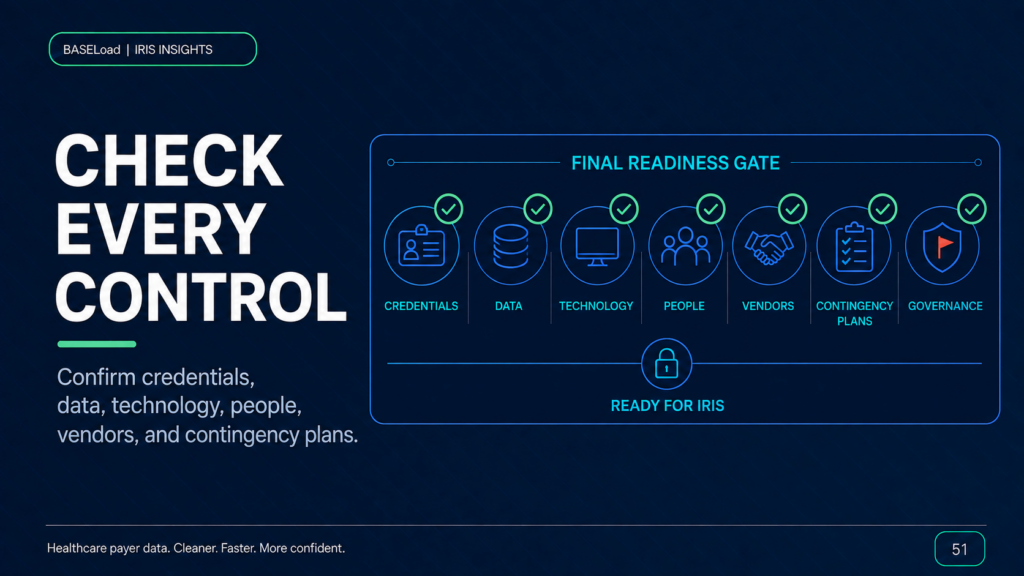
IRIS third-party transmitter responsibilities extend beyond sending a file.
The transmitter may own the technical connection, but the healthcare payer still owns data accuracy, approval, oversight, security, evidence, and long-term filing continuity.
The strongest relationship is built on documented responsibilities, measurable service levels, complete filing records, supported correction workflows, and clear communication.
Outsourcing should reduce operational weight.
It should not reduce visibility.
BASELoad Can Help Bridge Provider Data and IRIS Filing Operations
BASELoad helps healthcare payers prepare more reliable provider information before it reaches the transmitter. Its W-9 Corrections process supports TIN and legal-name research, address correction, provider outreach, quarterly data review, CP2100 support, and files drawn from multiple systems.
That preparation can reduce the number of unresolved provider-data issues handed to the filing vendor during live season.
Contact BASELoad to strengthen the provider-data controls your organization still owns when working with an IRIS third-party transmitter.