

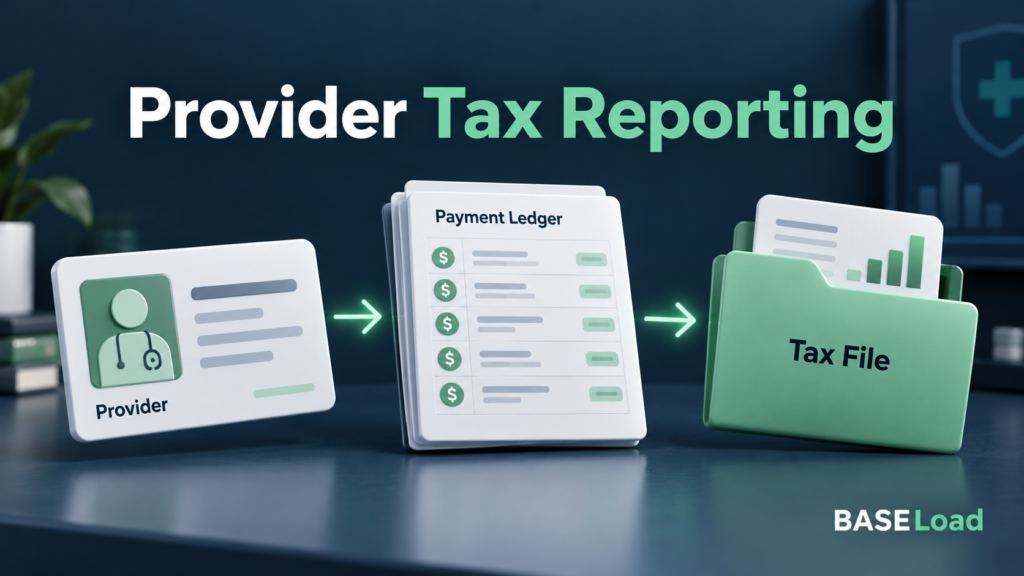
Provider tax reporting connects information collected during onboarding with the amounts and identities reported at year-end. When those stages are managed separately, the organization can end up with a completed W-9 in one system, an outdated tax name in another, and a filing export that uses neither correctly. The solution is a clear data process with evidence at every handoff.
This guide focuses on payer-side information reporting for provider payments. It does not address a provider’s own income-tax return or every tax obligation of a medical practice. For healthcare payers, the practical goal is to establish which recipient should be reported, which payments belong to that recipient, and how approved information reaches the final return.
Define the scope of provider tax reporting
Begin by naming the reporting entities and payment sources in scope. A health plan, an administrator, and a funding entity may participate in the same payment arrangement without having identical responsibilities. Have your tax and legal owners confirm the reporting role for each arrangement. The party operating a claims platform is not automatically the answer to every payer-identity question.
Build a source inventory with a named owner for each dataset. Include acquired systems, manual payment processes, and adjustments that do not flow through the main claims application. Identify the evidence used to establish completeness. A year-end file should be the result of an approved scope, not simply whatever the familiar export button happens to produce.
Treat tax identity as a governed record
Separate legal tax name, practice or trade name, TIN, NPI, location, and correspondence address. Each field has a purpose. A record can be suitable for finding a provider in a directory and still be unsuitable for tax reporting. Define which sources support tax-identity decisions and how conflicting information reaches a reviewer.
The IRS instructions for requesting Form W-9 provide the foundation for collecting taxpayer information. Use the applicable instructions to determine what is required for your payment relationship. Do not fill gaps by inferring a tax identity solely from a website, business name, or operational identifier.
Maintain effective dates and document references. When a provider supplies new information, the reviewer should know whether it reflects an ownership change, a correction to an earlier error, or an administrative update. Those situations can have different implications for historical payments and future reporting. Preserve enough context to explain the approved treatment later.
Design the W-9-to-master-record handoff
A received document should enter a review queue before it updates reporting fields. Capture the date received, provider reference, document location, review outcome, and person approving the change. Use separate statuses for incomplete, under review, awaiting clarification, and approved. This makes the queue useful to both provider relations and the reporting team.
Agree on how approved information reaches every downstream system. If claims operations, accounts payable, and tax reporting maintain separate copies, an update may need several controlled handoffs. Assign an owner to each. Otherwise, the same provider can be repeatedly asked for information that the organization already has but has not propagated.
BASELoad’s W-9 Corrections service supports outreach and collection, while its broader tax-data work addresses provider-record issues. Discuss your authoritative source, exception workflow, and required output format when scoping support. A returned document and an approved production record are different deliverables and should be tracked accordingly.
Link payments to the correct reporting recipient
Create a documented crosswalk between source payment records and approved tax recipients. A group practice might have multiple internal provider IDs or locations. Do not aggregate by display name alone, and do not assume different internal IDs always represent different taxpayers. Use reviewed identity relationships and retain the ability to trace amounts back to the originating records.
Review unusual payment streams with the tax owner. Medical payments, administrative services, and other categories can require different treatment. The IRS 1099-MISC and 1099-NEC instructions distinguish medical and healthcare payments from other compensation. Apply the rules for the relevant tax year, including the 2026 threshold changes where applicable.
Reconcile before and after transformation. If the reporting population excludes a payment category or consolidates several source records, document why. An unexplained difference should remain an open issue until the appropriate owner resolves it. Manual balancing entries may make a total look right while hiding the underlying mapping problem.
Build an exception queue that produces decisions
Useful exception categories include missing TIN, conflicting tax name, missing documentation, uncertain recipient relationship, address problem, and payment reconciliation discrepancy. Give each category an owner, required evidence, and escalation route. A single “bad data” label tells the team too little about what to do next.
Measure aging and blocked decisions as well as volume. A small number of unresolved ownership changes can require more attention than a large batch of routine address updates. Review those cases early with people who can make the necessary decisions. The goal is to avoid sending ambiguous records downstream under a broad “cleaned” label.
For example, an illustrative administrator discovers that an acquired provider file uses trade names where another system stores legal names. The team should establish which values belong in tax reporting and retain the trade names for operational use. Replacing all names everywhere would solve one export problem by creating several new business problems.
Preserve evidence through filing and follow-up
Record the approved dataset version, release decision, control totals, and receiving party. Confirm that the filing layout uses the approved values rather than an older source extract. When another company transmits, define how responses and unresolved issues return to your team. A contract should lead to a practical exchange of records, not an assumption that all follow-up is someone else’s responsibility.
After filing, connect recipient questions and IRS notices to the original reporting history. Do not overwrite the original return when a provider asks for a change. Record the request, supporting evidence, tax review, and resulting action. That history helps distinguish a correction of prior information from a new event affecting future payments.
Keep IRIS readiness connected to data readiness
The IRS IRIS resources explain the available electronic filing channels. Your technical route needs approved input, trained operators, and a response-monitoring process. Access alone does not establish the correctness of your provider data, and clean data alone does not establish that the filing channel is ready.
Use a joint readiness review to bring these workstreams together. Ask whether the team can trace one representative record from documentation through payment aggregation and final output. Repeat the exercise with an exception that required review. A process that works only for clean records is not ready for the full reporting population.
Where BASELoad fits
BASELoad works with healthcare payer data and offers data optimization alongside provider tax-data correction services. Bring the team an aggregate view of your exception categories, source systems, and preparation timeline. Agree on what will be reviewed, what will be returned, and which decisions require your organization’s approval.
Explore the IRIS Resource Hub for additional preparation guidance, or contact BASELoad to discuss the work. Provider tax reporting improves when every field and handoff has a purpose, an owner, and supporting evidence. Use current IRS guidance and your tax advisers to determine the obligations that apply to your specific arrangements.