

FIRE trained many filing teams to think in batches.
Prepare the file.
Upload the file.
Wait for the result.
Investigate what went wrong.
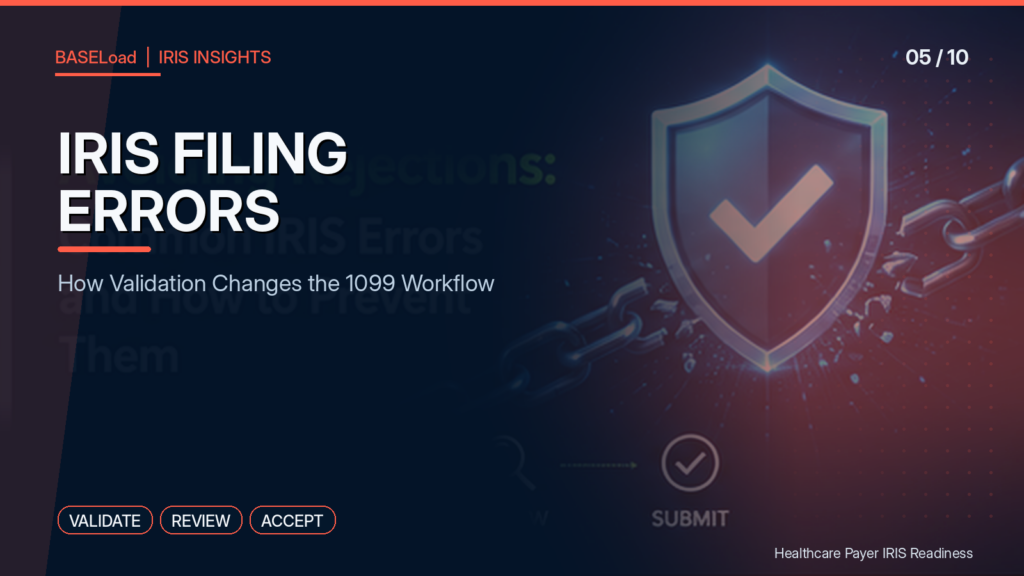
IRIS introduces a more structured validation and acknowledgment process, particularly for Application-to-Application filing.
That does not mean every return is instantly approved. IRIS A2A still processes submissions asynchronously, and organizations must retrieve and interpret the final acknowledgment.
What changes is the amount of structure surrounding the error.
IRIS checks transmission details, file format, schema compliance, business rules, form-specific information, identifiers, and other required elements. It then returns statuses and error information that should drive the next operational step.
For healthcare payers, this creates an opportunity.
It also creates a requirement.
Errors can become more actionable, but only if the organization has a workflow capable of acting on them.
IRIS Validation Occurs in Layers
The IRS A2A specifications describe a multi-step validation process.
IRIS first checks basic transmission elements, including whether the Unique Transmission Identifier has already been used. It stores the transmission, creates a Receipt ID and timestamp, and returns confirmation to the transmitter.
The transmission is then processed through more detailed checks, including:
- XML schema validation
- TCC and Software ID checks
- Transmission type
- Tax year
- Company information
- Form-specific business rules
- Error recording
Immediate problems can produce an early rejection. Format and business-rule errors are returned through the acknowledgment process.
This matters because “error” is no longer one undifferentiated category.
The location and severity of the issue determine what happens next.
A Receipt Is Not an Acceptance
One of the most important operational distinctions in IRIS is the difference between receipt and acceptance.
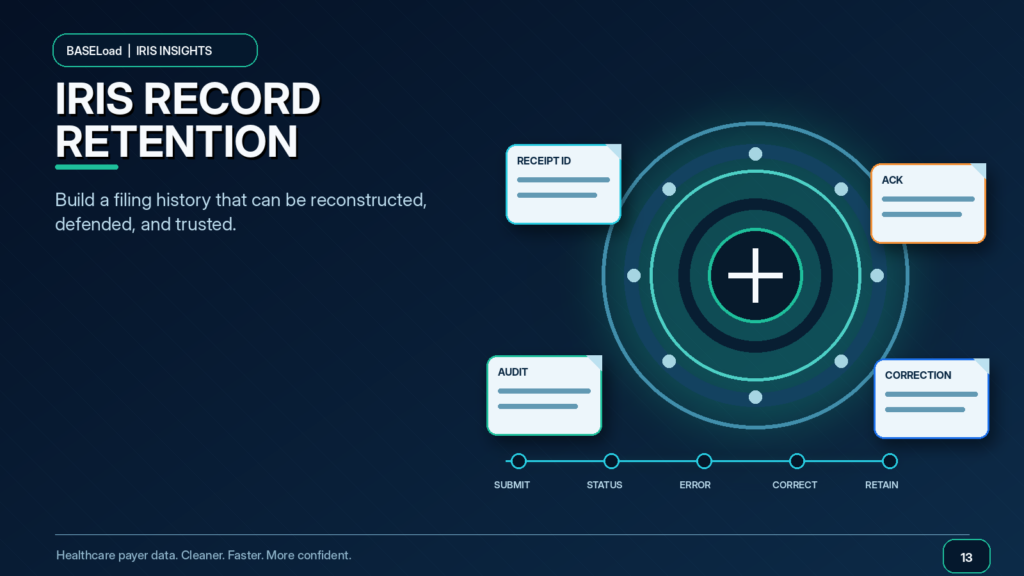
When a transmission is initially received, IRIS may return a Receipt ID, timestamp, and transmission identifier.
That confirms receipt.
The payload is then queued for additional processing.
A final status must still be retrieved.
A team that stops after receiving the Receipt ID may know that the IRS received something, but not whether the information was successfully processed.
That is the digital equivalent of having a package-tracking number without checking whether the package was delivered, rejected, or sent back.
A complete filing workflow must continue until a final status is known.
Understanding IRIS Statuses
IRIS A2A can return several statuses.
Accepted
The transmission was successfully processed and accepted.
Processing
IRIS has not completed processing. The organization must check again later.
Rejected
The transmission could not be processed successfully. Error information should be reviewed, and the appropriate resubmission or replacement process must be followed.
Partially Accepted
At least one submission was accepted and at least one was rejected.
Accepted with Errors
The transmission was processed and accepted, but errors were identified. Those errors may require corrections.
Not Found
The Receipt ID or Unique Transmission Identifier used in the request was not found.
The acknowledgment can include the TCC, transmission identifier, Receipt ID, form type, timestamp, status, and error information.
Each status is a routing instruction.
Without an internal routing process, the acknowledgment becomes a detailed message no one owns.
Schema Errors and Data Errors Are Different
Schema validation asks whether the transmission follows the technical structure IRIS expects.
That includes:
- Correct XML structure
- Required elements
- Valid data formats
- Supported schema versions
- Proper field relationships
- Acceptable characters
- Correct transmission metadata
Data and business-rule validation asks whether the submitted values comply with IRS requirements for the specific form and filing situation.
A transmission can fail because it is technically malformed.
It can also pass the structure checks and still contain provider-level errors.
Healthcare payers should distinguish between:
Technical errors
Usually owned by software, integration, or filing-vendor teams.
Provider-data errors
Often owned by tax operations, provider data, claims, W-9, finance, or compliance teams.
Process errors
Caused by incorrect transmission type, duplicated identifiers, wrong environment, outdated schema versions, or missing approvals.
The faster the error reaches the right owner, the faster it can be resolved.
Pre-Submission Validation Reduces Noise
The IRS recommends validating XML files against the applicable requirements before transmission. A validating parser can identify missing required elements, formatting issues, structural problems, and schema mismatches before the file reaches IRIS.
This is important because not every error deserves to become an IRS rejection.
Some problems can be prevented internally:
- Missing required fields
- Improperly formatted dates
- Invalid state codes
- Unsupported characters
- Outdated schema versions
- Duplicate transmission identifiers
- Incorrect form codes
- Empty required amounts
- TIN formatting issues
Pre-validation removes avoidable noise from the filing process.
It allows the filing team to focus on substantive provider-data issues instead of spending filing season repairing preventable file-construction mistakes.
Error Messages Need Translation
Technical error codes may make sense to developers.
They do not always make sense to the person responsible for correcting the provider record.
A useful operational process should translate each error into:
- What happened
- Which provider or record is affected
- Which source field caused the problem
- Which department owns the correction
- Whether the issue requires a correction or replacement
- What documentation should be retained
- Whether the source system must also be updated
The attached technical overview recommends mapping IRS errors into a structured internal model and linking them back to the source record and client data source.
That translation layer is where technical feedback becomes operational work.
Without it, employees may be handed raw IRS messages and asked to decipher them while deadlines continue moving.
Fix the Source, Not Only the Filing File
When a provider record causes an error, the immediate temptation is to repair the filing copy and resubmit it.
That may solve the current transaction.
It may not solve the underlying problem.
If the claims system, provider master, W-9 repository, or payment platform still contains the incorrect value, the same error may return in another report, another form, or another filing year.
A strong correction process should ask two questions:
- What must be changed to complete this filing?
- What must be changed so the problem does not return?
The second question is where long-term savings begin.
Otherwise, the organization creates a polished annual ritual around fixing the same records.
Measure the Error Process
IRIS error reporting gives organizations an opportunity to improve their operations.
Useful measures include:
- Total records submitted
- Acceptance rate
- Rejection rate
- Accepted-with-errors rate
- Most common error categories
- Errors by source system
- Errors by provider type
- Time to resolution
- Corrections required
- Replacements required
- Repeat errors from prior years
- Manual hours spent per error
These measures help leadership distinguish between one unusual filing issue and a systemic data-quality problem.
For example, repeated TIN/name mismatches may indicate weak W-9 collection.
Repeated address errors may indicate poor source selection.
Repeated technical rejections may indicate a schema or vendor configuration issue.
The acknowledgment is not only a result.
It is diagnostic data.
Do Not Wait Until Filing Season to Build the Workflow
An organization should determine how errors will be handled before the first live transmission.
That plan should specify:
- Who retrieves acknowledgments
- How often Processing statuses are checked
- Where Receipt IDs are stored
- How errors are assigned
- Who distinguishes corrections from replacements
- Who approves resubmission
- How corrected recipient copies are handled
- How vendors communicate status
- How management is notified of unresolved issues
- What happens when deadlines are at risk
Testing should include the people and process, not only the software.
A technically successful transmission does not prove the operations team knows what to do when thirty provider records return with different problems.
Final Thoughts
IRIS can provide more structured validation and more detailed filing outcomes.
That is valuable.
But visibility is only useful when it leads to action.
Healthcare payers need a process that continues beyond submission, follows each transmission to its final status, translates errors into understandable work, assigns ownership, corrects source systems, and retains evidence of what happened.
IRIS filing errors should not become a new queue that quietly grows in the corner.
They should become signals that improve the filing process over time.
BASELoad Can Help Reduce and Resolve IRIS Filing Errors
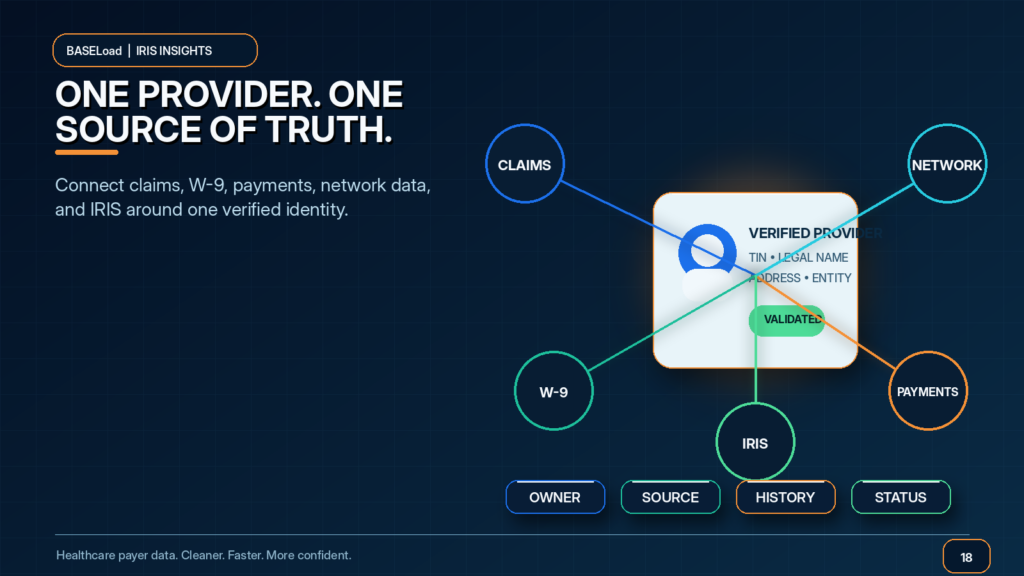
BASELoad helps healthcare payers address many of the provider-data problems that can create filing errors, including invalid TIN and legal-name combinations, incomplete W-9 information, incorrect addresses, and inconsistent provider records.
By improving the data before filing and helping teams resolve exceptions earlier, BASELoad can reduce last-minute research and support a cleaner transition into IRIS.
Contact BASELoad to strengthen your pre-submission validation and provider-data correction process before IRIS errors begin controlling your filing calendar.