

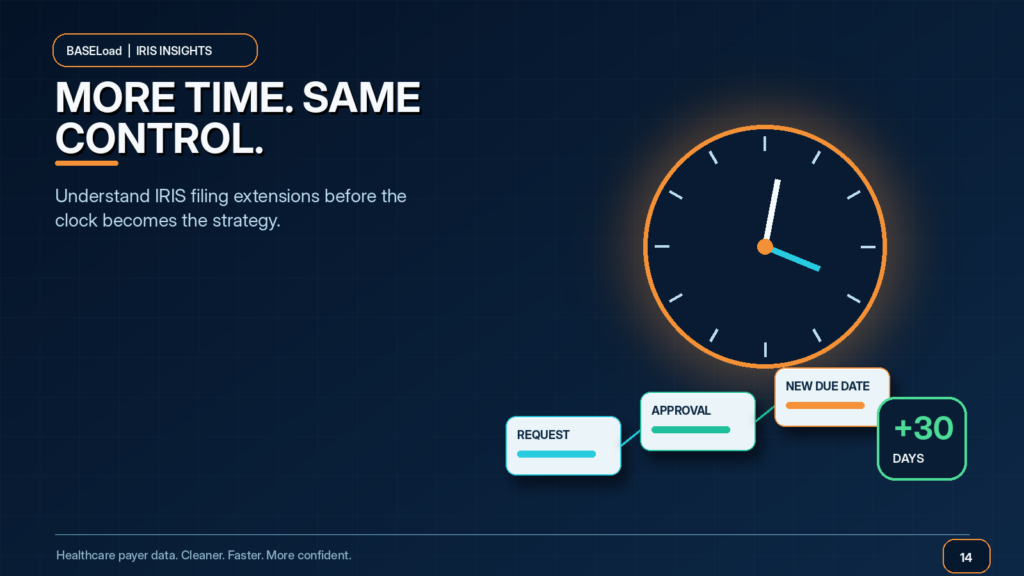
An extension can provide more time.
It does not provide less responsibility.
Healthcare payers moving to IRIS need to understand that several different deadline-relief processes may apply to information returns.
An extension of time to file with the IRS is not the same as an extension of time to furnish a statement to a provider.
An electronic-filing hardship waiver is not the same as either extension.
Some information returns may qualify for an automatic 30-day extension.
Form 1099-NEC reporting nonemployee compensation follows a different process.
A rejected extension request may need to be submitted again as an original.
That is a lot of procedural branching for something commonly summarized as “file an extension.”
A reliable IRIS extension of time to file process must distinguish each request, assign ownership, preserve evidence, and confirm what deadline was actually extended.
IRIS Supports Certain Automatic Extension Requests
Publication 5718 states that filers may transmit requests for an automatic 30-day extension for forms included in IRIS, subject to the applicable rules.
If an extension request is rejected, it cannot be corrected or replaced. It must be retransmitted as an original request.
That creates an important control point.
The organization should not assume that submission equals approval.
It must retain:
- The request date
- Issuer
- Forms covered
- Filing method
- Submission evidence
- Approval acknowledgment
- New filing deadline
- Responsible employee
- Any rejection and resubmission
An extension that was requested but not approved is not an approved extension.
Form 1099-NEC Requires Special Attention
For Form 1099-NEC reporting nonemployee compensation, an automatic 30-day extension is not available through the ordinary electronic process described in Publication 5718.
A nonautomatic extension request must be submitted on paper Form 8809.
This distinction matters to healthcare payers because provider compensation may be reported on Form 1099-NEC in appropriate circumstances.
The organization should not apply the process used for another information return and assume it also covers 1099-NEC.
The filing calendar should identify:
- Which forms are being filed
- Which extension rules apply
- Whether automatic relief is available
- Whether paper submission is required
- Who prepares the request
- Who approves it
- Where proof of mailing or submission is retained
- How the revised deadline is communicated
A general calendar entry labeled “1099 extension” is not precise enough.
Additional Extensions May Require Hardship
Publication 5718 also describes a potential additional 30-day extension under certain hardship conditions.
The initial extension must have been granted, and the request for additional time must be filed before that initial extension expires. The additional request is submitted on paper Form 8809.
This should not be treated as an automatic second month.
The organization should document the hardship basis, submission date, supporting materials, and IRS determination.
Leadership should also understand that needing an additional extension may signal a deeper operational problem.
Possible causes include:
- Incomplete provider data
- Delayed payment reconciliation
- Missing W-9s
- Unresolved system conversion issues
- Vendor delays
- Failed testing
- Unclear filing ownership
- Large numbers of exceptions
The extension addresses the deadline.
It does not resolve the underlying cause.
Recipient Statements Have a Separate Extension Process
An extension of time to file information returns with the IRS does not automatically extend the deadline for furnishing statements to recipients.
Publication 5718 states that an extension to furnish recipient statements may be requested using Form 15397.
The request must be received no later than the date the statements are due. If approved, the filer will generally receive a maximum of 30 additional days to furnish the statements.
For healthcare payers, this means the filing calendar should track at least two distinct deadlines:
- The deadline to file with the IRS
- The deadline to furnish the provider copy
The operational owners may also be different.
The tax or finance team may manage IRS submission.
A print-and-mail vendor, provider portal, operations team, or third-party service may manage recipient copies.
Unless those groups coordinate, one deadline can be extended while the other remains unchanged.
An E-Filing Waiver Is Not an Extension
The IRS generally requires electronic filing when an organization meets the applicable aggregate threshold.
A hardship waiver from the electronic-filing requirement may be requested using Form 8508.
Publication 5718 states that a separate Form 8508 is required for each issuer and should generally be submitted at least 45 days before the information return due date. The form itself cannot be filed electronically.
A waiver changes the filing method requirement when approved.
It does not automatically change the filing deadline.
This distinction should be documented in payer procedures.
Otherwise, an employee may mistakenly treat an approved waiver as additional filing time.
Build an Extension Decision Tree
A practical extension workflow should begin with a decision tree.
Which form is involved?
The available process can depend on the information-return type.
Is the organization extending the IRS filing deadline or the recipient-copy deadline?
These are separate requests.
Is an automatic extension available?
Do not assume it applies to every form.
Was the request complete, accurate, and timely?
Late or incomplete requests may not produce approval.
Was the extension accepted?
Retain the approval acknowledgment.
Was it rejected?
Determine whether it must be retransmitted as an original or handled through another process.
Is additional time required?
Confirm whether hardship criteria and paper submission apply.
Does the filing method also require a waiver?
Handle that separately.
The decision tree should identify the responsible employee and required evidence at every step.
Do Not Use Extensions as a Data Strategy
Extensions can be appropriate.
They should not become the organization’s default solution for unresolved provider data.
If the same issues cause delay every year, the problem is probably upstream.
Common recurring causes include:
- Providers added without valid W-9s
- TIN and legal-name combinations not validated
- Addresses maintained inconsistently
- Payments split across multiple provider records
- Claims and finance systems not reconciled
- Exception ownership left unclear
- Provider outreach beginning too late
A stronger process begins correcting those issues throughout the year.
That reduces the number of records still waiting for research when the original deadline arrives.
Create an Extension Control Log
Every extension request should be entered into a centralized log containing:
- Issuer
- EIN
- Form type
- Tax year
- Original due date
- Extension type
- Request date
- Submission method
- Responsible employee
- Approval status
- Acknowledgment or mailing evidence
- Revised due date
- Recipient-copy impact
- Open risks
- Final filing date
The log should be reviewed by someone other than the employee who submitted the request.
That simple separation helps prevent missed approvals, incorrect assumptions, and silent deadline failures.
Communicate the Revised Deadline Carefully
When an extension is approved, notify every team affected by the new timeline.
That may include:
- Finance
- Tax
- Provider data
- Claims
- Compliance
- Information technology
- Filing vendor
- Printing and mailing vendor
- Provider-relations team
- Executive sponsor
The notification should specify exactly what was extended.
Do not say, “The 1099 deadline was extended.”
Say which issuer, form, filing obligation, and deadline were changed.
Precision keeps the organization from extending one task in conversation while leaving another task unaddressed in reality.
Final Thoughts
The IRIS extension of time to file process is not a single universal request.
Different forms and obligations can require different procedures.
Healthcare payers should distinguish IRS filing extensions, recipient-copy extensions, additional hardship extensions, and electronic-filing waivers.
Every request should be timely, approved, documented, communicated, and connected to the correct issuer and form.
An extension can create valuable breathing room.
A controlled process ensures that breathing room does not become false confidence.
BASELoad Can Help Reduce the Data Pressure Behind Extension Requests
BASELoad helps healthcare payers correct provider TIN and legal-name mismatches, improve address information, gather missing W-9 data, conduct provider outreach, and process quarterly mock files before live season.
By resolving more exceptions during the year, payer teams can reduce the volume of unfinished data that reaches the filing deadline.
Contact BASELoad to strengthen your provider-data process before an IRIS extension of time to file becomes the only thing standing between your organization and a missed deadline.