

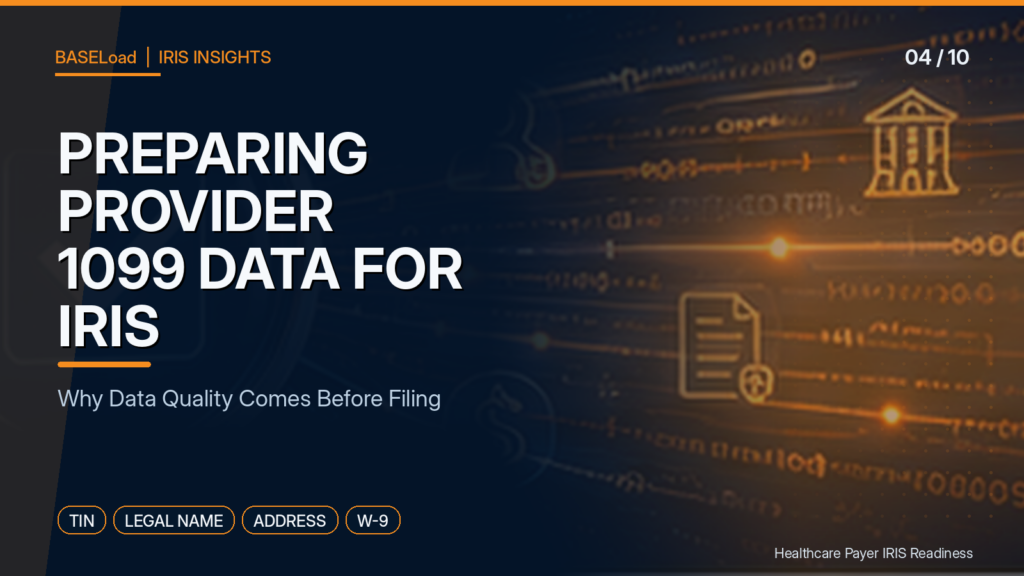
The transition to IRIS is often discussed as a filing-system project.
That is understandable.
FIRE is retiring. IRIS is taking its place. New authorizations are required. New transmission methods must be understood. Testing must be completed.
But a filing system can only process the information it receives.
For healthcare payers, the success of an IRIS filing will depend heavily on the condition of the provider data arriving at the front door.
An incorrect Taxpayer Identification Number does not become correct because it is transmitted through XML.
A provider’s outdated legal name does not repair itself inside a modern platform.
A duplicate provider record does not disappear because the IRS returns a more detailed acknowledgment.
IRIS may make errors more visible.
Data preparation determines how many errors exist to be found.
The Filing Process Begins Months Before Submission
Many organizations think of 1099 preparation as a year-end event.
That is when the urgency becomes visible, but the underlying information has been accumulating all year.
Provider names are entered.
Tax IDs are collected.
Addresses change.
Organizations merge.
Payments are made.
W-9s are requested.
Claims systems create new provider records.
Employees correct one field in one system but not another.
By the time the filing file is assembled, it may contain twelve months of operational history compressed into a spreadsheet or export.
That means the filing team is not only preparing tax forms.
It is inheriting every unresolved data decision that came before them.
Strong IRIS 1099 data preparation starts earlier, when there is still time to investigate and correct those decisions.
TIN and Legal-Name Alignment Remains Critical
A provider’s TIN and legal name must represent a valid combination.
This sounds basic.
In real healthcare payer environments, it can be surprisingly difficult.
A provider may submit a W-9 using a professional association, an individual name, a group entity, or a doing-business-as name. Internal systems may store a shortened version. Claims may arrive under another variation. Payment records may use the name of a parent company. Historical files may contain a former entity name.
Each version may look plausible.
Only one may align correctly with the taxpayer record being reported.
The risk is not limited to a mistyped number. It includes an identity mismatch between the TIN and the entity attached to it.
BASELoad’s 1099 Corrections service is specifically designed to identify and resolve healthcare-provider TIN and legal-name mismatches before filing.
Address Quality Still Matters
TIN and legal-name alignment tends to receive the most attention, but address quality can create its own operational damage.
Bad addresses can lead to:
- Returned recipient copies
- Additional mailing costs
- Delayed provider communication
- Manual research
- Reissued forms
- Incomplete records
- Increased call volume
- Difficulty demonstrating that required copies were furnished
Healthcare provider addresses are especially fluid.
A practitioner may have a billing address, practice address, mailing address, corporate address, payment address, and historical address. Systems may not agree on which one should be used.
An address should not be selected merely because it is the first populated field.
The organization needs a rule for which address controls the tax-reporting process and a method for validating that address before recipient copies are produced.
Duplicates Create More Than Duplicate Work
Duplicate provider records are often treated as a database housekeeping issue.
During 1099 preparation, they can become a filing issue.
The same provider may appear under:
- Multiple internal IDs
- Slightly different names
- Different locations
- Old and new TINs
- Individual and group entities
- Separate claim platforms
- Acquired or legacy systems
Not every similar record should be merged.
Some represent legitimate distinctions.
But unresolved duplicates can divide payment totals, create conflicting tax records, produce multiple forms, or cause teams to report against the wrong entity.
This is why duplicate resolution requires more than fuzzy name matching.
The payer needs to determine whether the records represent the same taxpayer, related taxpayers, or separate business contexts that must remain distinct.
A clean filing file should reflect deliberate identity decisions, not accidental database structure.
Missing Data Becomes a Workflow Problem
IRIS validates transmissions against schemas and business rules.
The IRS validation process checks file structure, required information, transmission metadata, tax year, company information, and form-specific content. Missing required fields or incorrectly formatted data can cause a submission to be rejected or returned with errors.
Missing data therefore creates two problems.
First, the field is absent.
Second, someone must stop the filing workflow to determine where the information should come from.
That second problem is usually more expensive.
During filing season, the person researching the missing information may need to search claims systems, contact another department, locate a W-9, call a provider, review a contract, or ask a vendor for assistance.
One blank field can open five doors.
The best time to resolve missing data is before submission deadlines compress every decision.
Standardization Makes Validation More Effective
A strong preparation process should standardize incoming information before it is mapped into the filing structure.
That may include:
- Consistent TIN formatting
- Standard legal-name rules
- Address normalization
- State and postal-code formatting
- Removal of prohibited characters
- Required-field checks
- Duplicate detection
- Consistent account identifiers
- Form-specific data validation
The attached technical overview recommends separating data normalization from schema validation and business-rule validation. It treats the IRIS process as an end-to-end pipeline rather than a single upload event.
That distinction is useful.
Schema validation asks whether the file is built correctly.
Data-quality validation asks whether the information inside the file is trustworthy.
A file can be technically perfect and factually wrong.
Healthcare payers need both levels of control.
Do Not Confuse Acceptance with Accuracy
An accepted transmission means the IRS successfully processed the submission under the applicable rules.
It does not necessarily mean every provider record was assembled from the best available source.
It does not confirm that the payer selected the intended address.
It does not resolve whether two internal records represented the same entity.
It does not prove that a provider’s W-9 was current when the data was collected.
Technical acceptance and operational accuracy overlap, but they are not identical.
That is why payer organizations should not measure success only by whether the file cleared the IRS system.
They should also measure:
- How many records required manual correction
- How many W-9s were missing
- How many TIN/name combinations were unresolved
- How many recipient copies were returned
- How many corrections were required after filing
- How much staff time the process consumed
- How many issues repeated from the prior year
Those measures reveal whether the underlying process is improving.
Quarterly Preparation Is Better Than Annual Rescue
A year-end-only process turns every problem into an emergency.
A quarterly or recurring preparation model creates room to:
- Review new provider records
- Validate TIN and legal-name combinations
- Request missing W-9s
- Correct addresses
- Resolve duplicate entities
- Document outreach
- Reconcile payment data
- Track unresolved exceptions
- Improve the confirmed provider database
BASELoad’s W-9 and 1099 process is designed around proactive work throughout the year rather than waiting until filing season to discover every error at once. Its services include direct provider outreach, portal-based tracking, TIN and legal-name validation, and secure handling of sensitive tax data.
Quarterly preparation does not eliminate filing-season work.
It prevents filing season from becoming a data-recovery expedition.
Assign an Owner to Every Exception
One of the most common reasons data issues linger is that no one owns the exception.
The tax team identifies the mismatch.
Provider operations believes the W-9 team should resolve it.
The W-9 team believes the provider-relations department owns outreach.
Provider relations believes the claims system contains the answer.
Information technology explains that it only exports what the system stores.
The record circles the organization while the deadline approaches.
A useful exception process should identify:
- The error
- The affected provider
- The relevant source systems
- The assigned owner
- The required action
- The date assigned
- The status
- Supporting documentation
- The final resolution
- Whether the source record was permanently corrected
Without ownership, the same error can return next year wearing a different spreadsheet row.
Build a Pre-Filing Quality Gate
Before provider data is converted into an IRIS submission, it should pass a defined quality gate.
That gate might include:
- TIN format review
- TIN and legal-name validation
- Required-field checks
- Address validation
- Duplicate review
- Payment reconciliation
- Form-type confirmation
- W-9 documentation review
- Exception resolution
- Final approval and audit documentation
The gate should be measurable.
Leadership should be able to see how many records passed, how many failed, why they failed, and what remains unresolved.
This transforms data quality from a vague expectation into an operational control.
Final Thoughts
IRIS changes the submission environment.
It does not change the basic truth of information-return filing:
The output is only as reliable as the data behind it.
Healthcare payers that begin with TCCs and transmission methods but ignore provider-data quality may complete the technical transition and still experience the same correction burden, provider outreach, returned mail, manual research, and year-end stress.
The strongest IRIS strategy begins upstream.
Clean the data before asking the filing system to judge it.
BASELoad Can Strengthen Your IRIS 1099 Data Preparation
BASELoad helps healthcare payers prepare cleaner provider tax data by correcting TIN and legal-name mismatches, improving address information, collecting W-9s, validating provider records, and documenting unresolved exceptions.
The service accepts data in virtually any format and can reduce the amount of manual intervention placed on finance, claims, provider-data, and tax teams.
Contact BASELoad to begin preparing your provider 1099 data for IRIS before filing season turns today’s exceptions into tomorrow’s rejections.