

Every filing plan looks clean before the first error arrives.
The file will be prepared.
The transmission will be sent.
The acknowledgment will be received.
The filing will be accepted.
Then a provider reports that the legal name is wrong.
A TIN mismatch appears.
An amount was reported incorrectly.
One submission is rejected while the others are accepted.
The wrong form type was used.
That is where the real filing process begins.
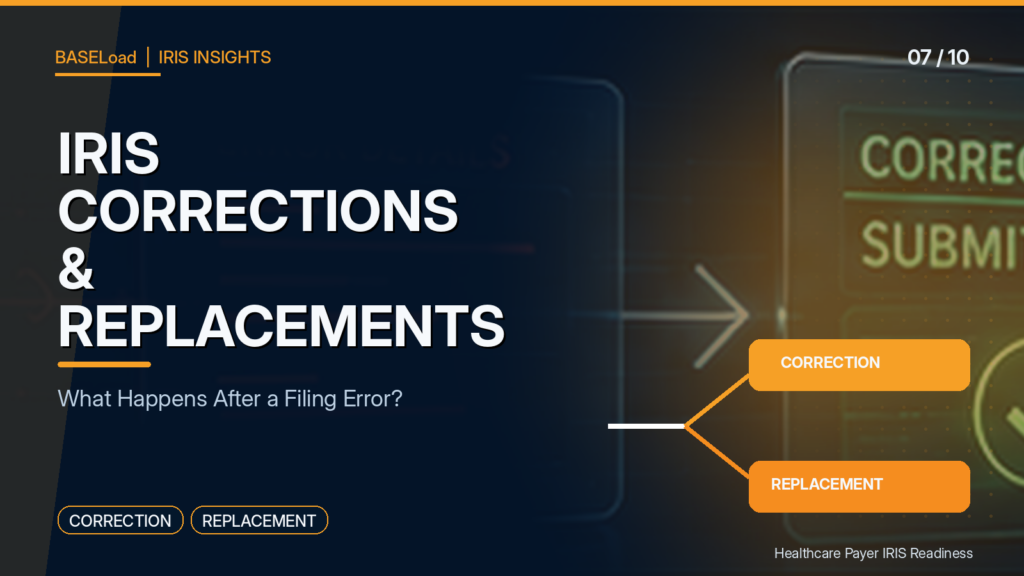
IRIS distinguishes between corrections and replacements, and the correct response depends on what status the IRS returned and what type of problem occurred.
Healthcare payers should understand that distinction before live filing begins.
Otherwise, the first error becomes a training exercise conducted under deadline pressure.
Correction and Replacement Are Not Interchangeable
A correction generally changes a record that was previously accepted or accepted with errors.
A replacement addresses a submission or transmission that was rejected and could not be processed as filed.
The current IRIS A2A specifications state that corrections can be made to records with Accepted or Accepted with Errors statuses. Rejected submissions may require replacement procedures, depending on where and how the rejection occurred.
This difference matters because resubmitting an original record incorrectly can create duplicate reporting.
The IRS specifically warns filers not to submit another original when a correction is required.
The response must match the status.
Start with the Final Acknowledgment
The first step is not editing the file.
It is understanding the acknowledgment.
IRIS may return:
- Accepted
- Processing
- Rejected
- Partially Accepted
- Accepted with Errors
- Not Found
A Processing status means the result is not final.
A Partially Accepted status means some submissions succeeded while others did not.
An Accepted with Errors status means the transmission was processed and accepted, but specific errors remain.
A Rejected status means the transmission or submission could not be processed successfully.
The acknowledgment should identify the status and provide available error information.
The organization should not begin changing data until it understands which records are affected and which filing procedure applies.
Receipt IDs Are Operational Assets
IRIS uses identifiers to connect transmissions, submissions, records, corrections, and replacements.
A corrected record must reference the appropriate UniqueRecordId. That identifier combines the Receipt ID, Submission ID, and Record ID associated with the previously accepted information return.
In practical terms, this means Receipt IDs and related identifiers cannot be treated as disposable system messages.
They are part of the organization’s correction infrastructure.
Healthcare payers should retain:
- Receipt ID
- Unique Transmission Identifier
- Submission ID
- Record ID
- Final acknowledgment
- Error information
- Corrected record reference
- Replacement reference
- Filing date
- Responsible employee or vendor
Losing those records can make a future correction much more difficult.
Common Reasons for Corrections
The IRS describes several errors that may be addressed through correction procedures, including:
- Incorrect recipient name
- Incorrect TIN
- Incorrect payment amount
- Incorrect code or indicator
- A form that should not have been filed
- Incorrect form type
Most errors can use a one-step correction. An incorrect form type may require a two-step process, including zeroing out the original amounts and then submitting the correct form as an original after the first correction is accepted.
For healthcare payers, common correction triggers may arise from:
- Invalid W-9 information
- Provider entity changes
- Payments assigned to the wrong taxpayer
- Incorrect legal-name selection
- Duplicated provider records
- Incomplete year-end reconciliation
- Changes reported by the provider after filing
- Data mapped from the wrong source field
The filing correction is only the visible repair.
The organization should also determine why the source process produced the wrong information.
When a Replacement May Be Required
A replacement is generally associated with a rejected transmission or submission.
However, not every rejection is handled in exactly the same way.
A transmission rejected before a Receipt ID is issued may need to be fixed and resent using the appropriate transmission type.
An XML schema validation error may return a Receipt ID but still require the file to be resent as an original rather than replaced.
A rejected submission within a partially accepted transmission may require a replacement submission that references the original rejected item.
The exact procedure depends on the point of failure and the acknowledgment details.
This is why organizations should avoid creating a universal “resubmit” button.
A generic resubmission procedure can produce the wrong filing action.
Keep Originals and Corrections Separate
IRIS correction procedures require corrected records to be submitted in a correction transmission.
Original and corrected records should not be mixed in the same transmission payload.
The corrected record must include the complete record, not merely the field that changed. It must also contain the required correction indicator and reference information linking it to the prior accepted record.
This has an important data-management implication.
The organization must be able to reconstruct the full record as it should appear after correction.
It cannot rely on a loose note saying “change the provider name.”
The correction process needs:
- The original record
- The accepted identifiers
- The corrected values
- The unchanged values
- The reason for correction
- The approval
- The final corrected acknowledgment
That is an audit trail, not merely a file edit.
Correct the Provider Copy Too
A filing correction does not end with the IRS transmission.
When applicable, the recipient must also receive a corrected information return.
Healthcare payer workflows should therefore connect:
- IRS correction
- Provider communication
- Corrected recipient copy
- Mailing or delivery evidence
- Internal provider record update
- Payment-system update
- W-9 documentation
- Exception closure
A correction handled only inside the filing system can leave the provider and the organization’s own source systems carrying conflicting information.
The filing record should not be the only place where the truth was repaired.
Third-Party Transmitters Must Provide Evidence
The IRS advises businesses using third-party transmitters to obtain copies of all electronic records submitted on their behalf, the Receipt ID for each transmission, and the final acknowledgment containing the status and errors.
This information is especially important if the transmitter later becomes unavailable. Without it, the filer may struggle to make corrections independently.
Healthcare payers should require their vendors to provide:
- Submission-level records
- Receipt IDs
- Final acknowledgments
- Error details
- Correction confirmations
- Replacement confirmations
- Final accepted status
- Clear retention terms
- Exportable filing history
The organization remains accountable for understanding what happened to its information returns.
Outsourcing transmission should not mean outsourcing visibility.
Build a Correction Decision Tree
A practical IRIS correction process should begin with a documented decision tree.
Is the status still Processing?
Wait and retrieve the final acknowledgment.
Was the record Accepted?
Use the correction process when a reportable value is wrong.
Was it Accepted with Errors?
Review the error details and submit the required corrections.
Was the entire transmission Rejected?
Determine whether it failed before receipt, during schema validation, or during later processing.
Was the transmission Partially Accepted?
Identify which submissions were accepted and which require replacement.
Was the wrong form used?
Follow the applicable two-step correction process.
Does the provider need a corrected copy?
Prepare and distribute it through the approved workflow.
This decision tree should identify owners and required documentation at every branch.
Use Corrections as Process Feedback
A correction is not merely a filing defect.
It is evidence about the upstream process.
Repeated TIN corrections may indicate poor W-9 validation.
Repeated legal-name corrections may indicate that payer systems are storing display names instead of tax-reporting names.
Repeated amount corrections may indicate reconciliation problems.
Repeated replacement transmissions may indicate technical configuration or schema issues.
Leadership should review correction patterns after filing season and ask:
- Which errors repeated?
- Which source systems produced them?
- Which providers were affected?
- Which controls failed?
- Which issues could have been prevented earlier?
- Which departments need process changes?
- Which vendor capabilities were insufficient?
The goal is not zero human imperfection.
The goal is fewer recurring errors.
Final Thoughts
IRIS corrections and replacements are structured processes tied to filing statuses, identifiers, acknowledgments, and specific error conditions.
They should not be improvised.
Healthcare payers need to preserve Receipt IDs, distinguish accepted records from rejected submissions, maintain complete filing histories, correct provider copies, and repair source data so the problem does not return.
A correction closes one filing issue.
A good correction process also prevents the next one.
BASELoad Can Help Reduce and Manage IRIS Corrections
BASELoad helps healthcare payers identify and correct provider-data problems before filing, including TIN and legal-name mismatches, invalid addresses, incomplete W-9 information, and other record inconsistencies.
When corrections are required, cleaner source data and documented provider outreach can make the resolution process faster and more defensible.
Contact BASELoad to build a more proactive provider-data process before IRIS corrections and replacements begin consuming your filing team’s time.